Tealight Candle Holder SVG: 12 Free Laser Cut Files
A candle holder is the first three-dimensional thing most people cut. It takes less than half a sheet, and unlike a sign it does not have to belong anywhere: it just sits on a table and works.
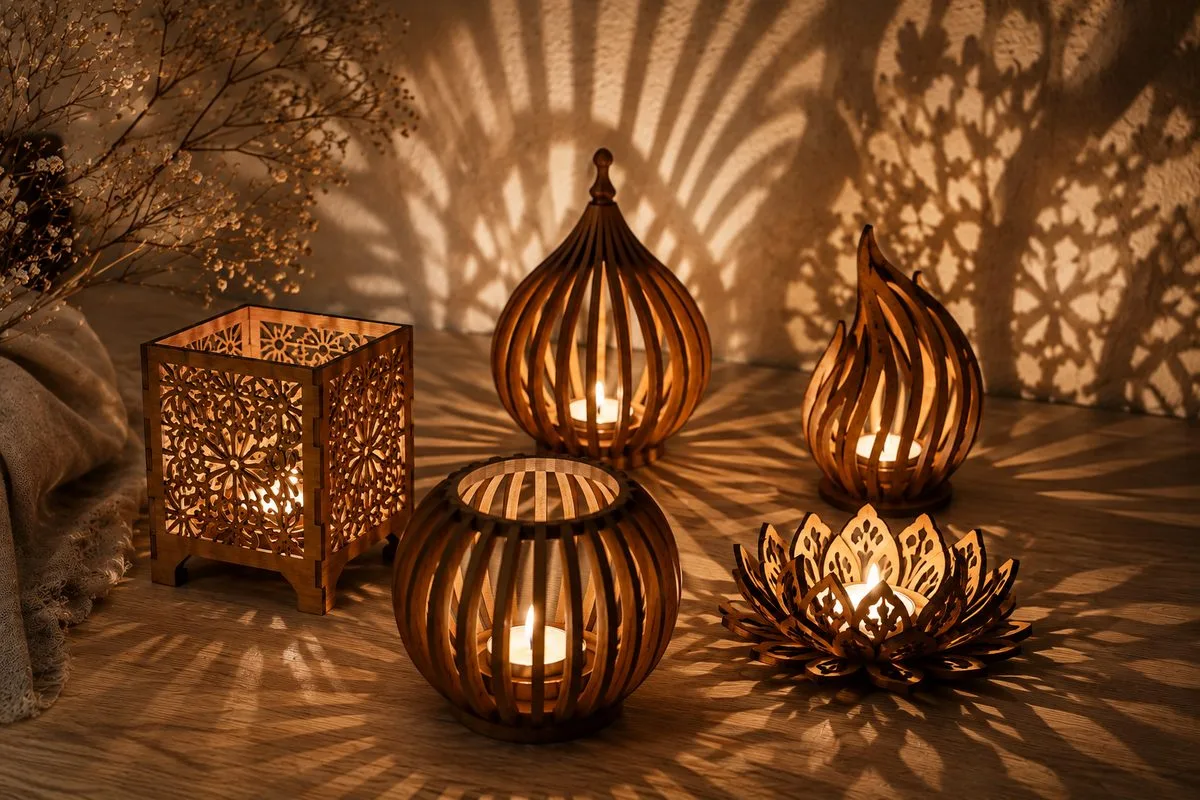
It also does something flat decor cannot. In daylight it is a pattern on wood. In the evening a candle goes inside, that same pattern lands on the wall as a shadow, and the object starts glowing from within. One cut, two things.
Below are twelve free files, from flat bases that go together in a minute to ribbed builds where two dozen slats seat onto rings.
Built from ribs
The principle is the same across all of them: upright slats seat onto rings, gaps are left between them, and the light comes out in bands. Glue is usually not needed — the joints hold it.
Lotus in Two Layers
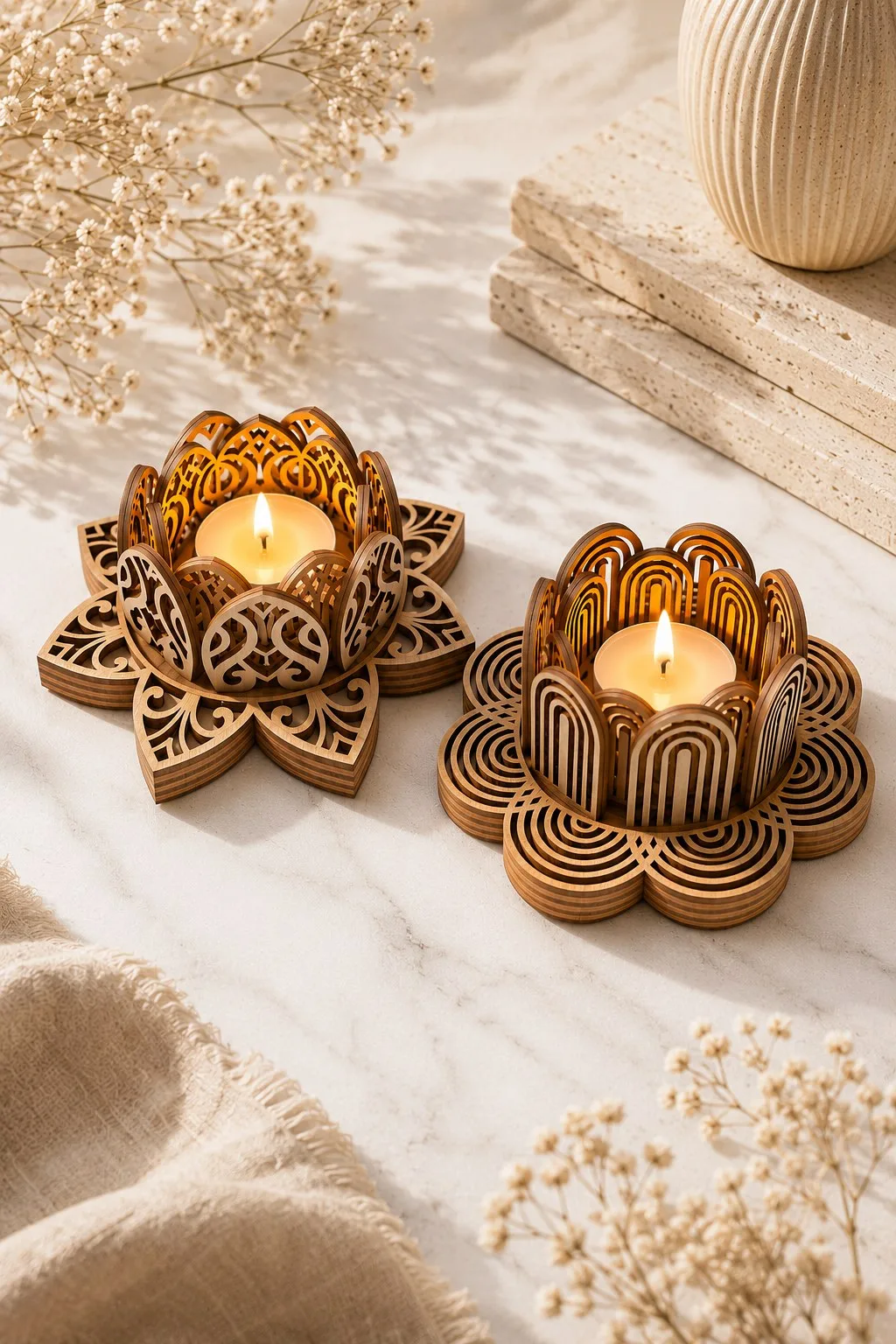
The one here that is not built from ribs. It goes together from two flat layers: a petal base lies on the table, and an upright wall of petals stands around the candle in a ring.
Two patterns come in the file and they throw different light. One has petals filled with scrollwork, the other with concentric arcs. The first drops a broken, lacy shadow; the second lays down stripes. The base is cut through as well, so the pattern carries across the table around the flower rather than stopping at its edge.
Sphere
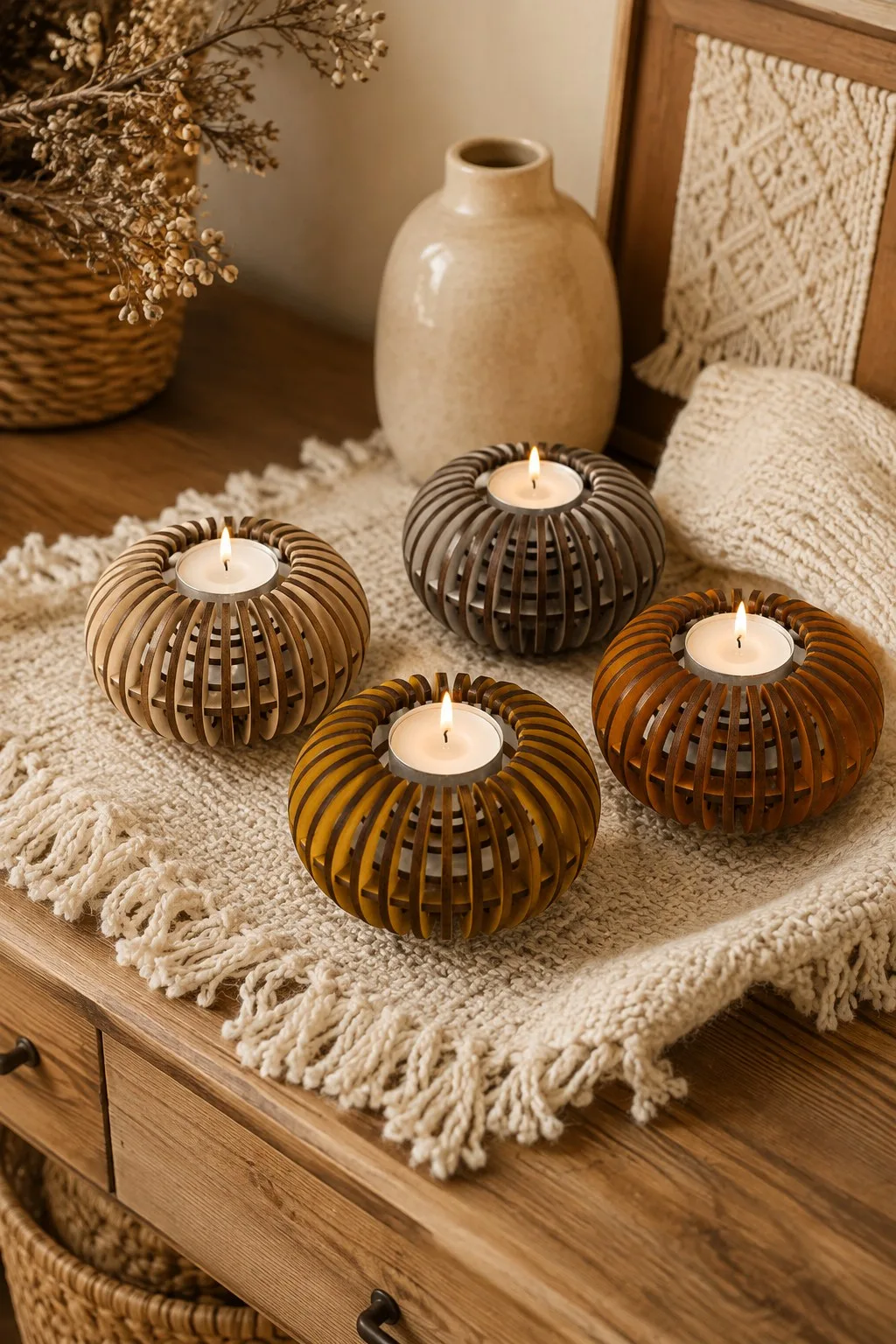
The classic shape and the most recognisable one: ribs run the full way round, the candle sits in a cup on top, and light leaves downwards and sideways in even bands.
The maker includes something almost nobody bothers with: a 3 by 3 cm reference square inside the file. Open it, measure the square, and you know straight away whether the scale has shifted. That single detail fixes the most common problem with somebody else’s SVG — the piece cuts at the wrong size and you only find out once it is off the bed.
For 3 mm material, wood or acrylic. Eight formats in the archive: AI, EPS, SVG, PDF, DXF, CDR, JPG and PNG. The maker says outright to use an electric candle, with a real tealight as the fallback.
Open Bud
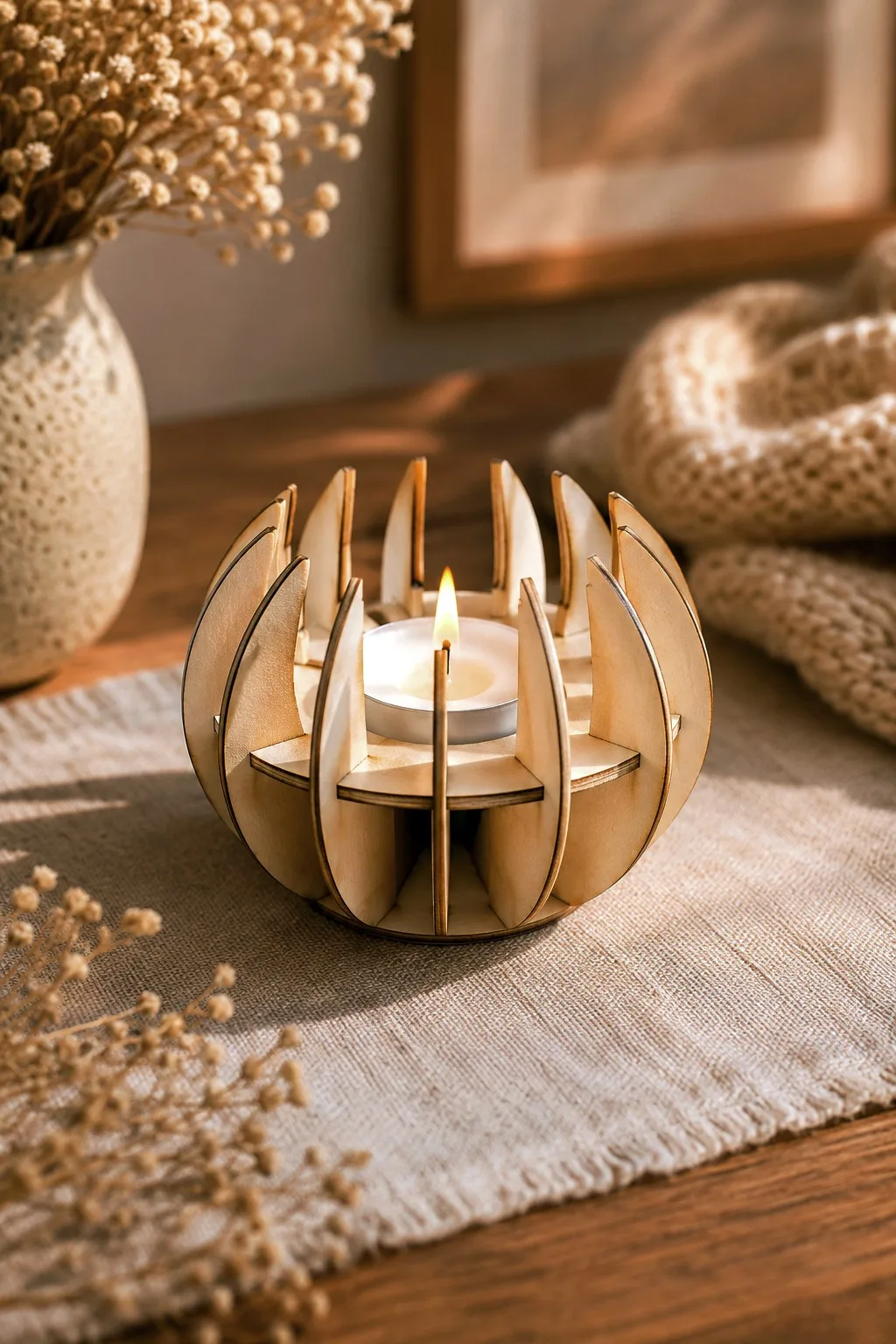
Same family as the sphere, built differently. The slats here are wide petals rather than narrow ribs, and they flare outwards instead of closing over the top, so the thing reads as a bud caught halfway open. The candle stands on a central post in the middle rather than sitting in a cup on the lid.
The practical difference is where the light goes. A closed sphere sends it sideways in bands; this one opens upward, so the flame itself stays visible and the glow lands on whatever is above it — a shelf, a face, the underside of a cabinet.
For 3 mm material. Formats: AI, CDR, DXF, EPS, PDF, SVG and JPG.
Cylinder and Barrel
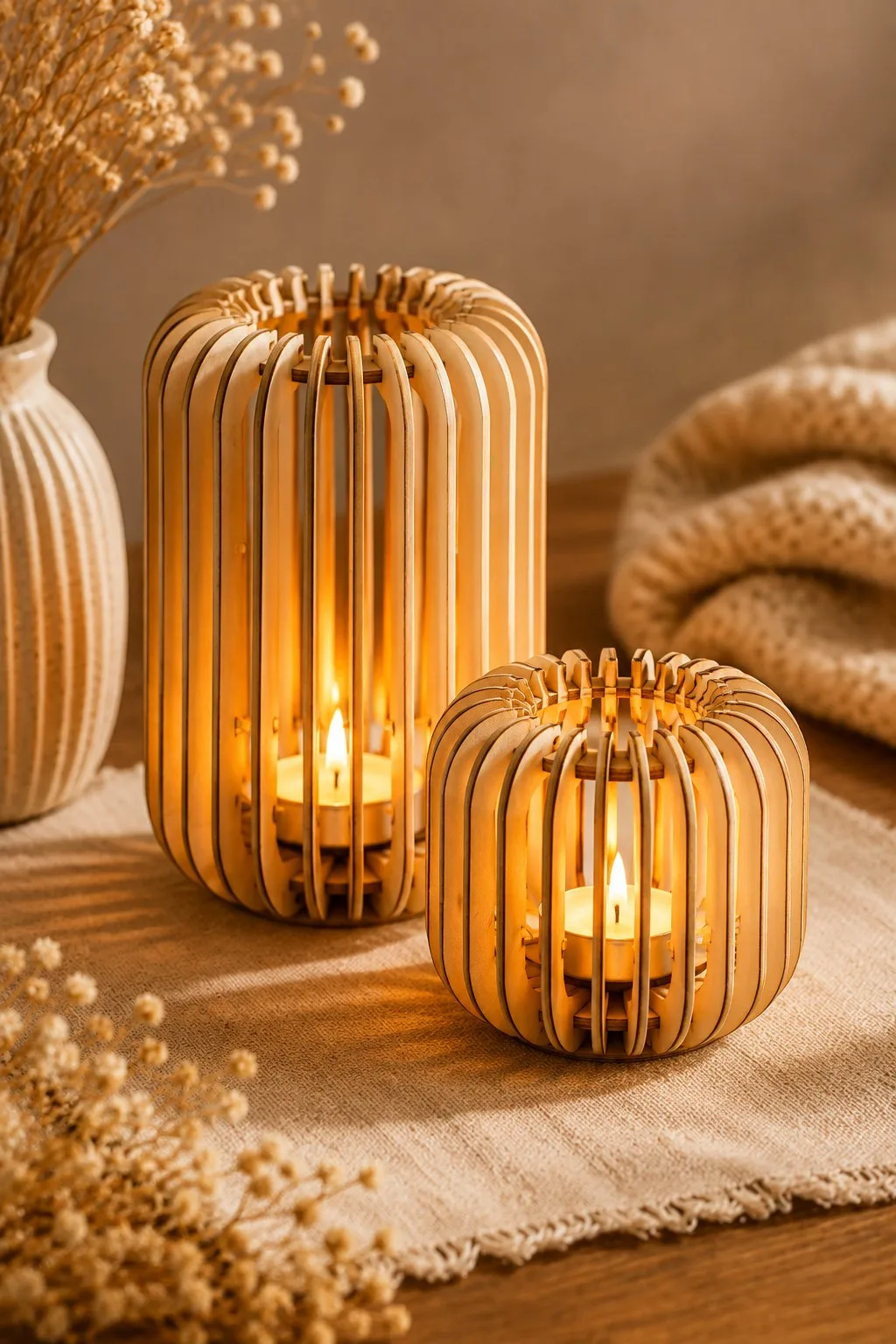
Two straight forms in one file: a tall cylinder at 180 mm and a squat barrel at 120 mm. The simplest to assemble and the steadiest of the ribbed group.
This is the first of three files by the same maker, and the approach is worth calling out. Drawings come ready for four thicknesses — 3, 3.2, 4 and 4.23 mm — so there is nothing to recalculate against your own plywood, you take the version that matches. An assembly video is included too.
One small snag people trip on: the files arrive as .rar rather than zip.
Onion Domes
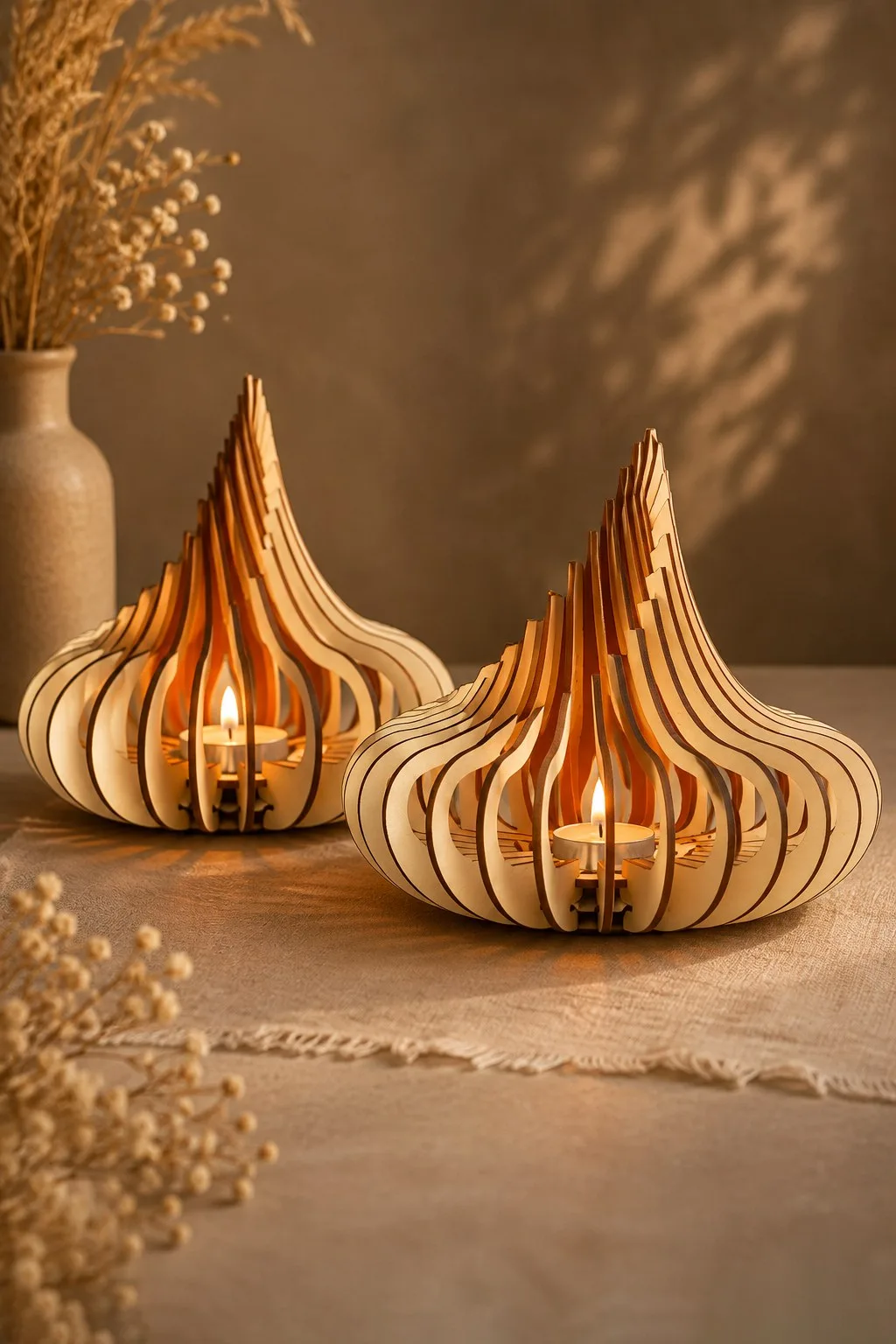
The ribs are drawn up to a point, and the silhouette reads as an onion dome. The light behaves differently from the sphere: a wide base drops a pool onto the table while the narrow top sends a thin beam at the ceiling.
Two sizes in the file, and the gap between them is real — 120 mm tall by 150 across, and 165 by 197. The second is not a shelf trinket any more, it is a piece that holds a table.
Same maker: four thicknesses to choose from, assembly video included.
Flame
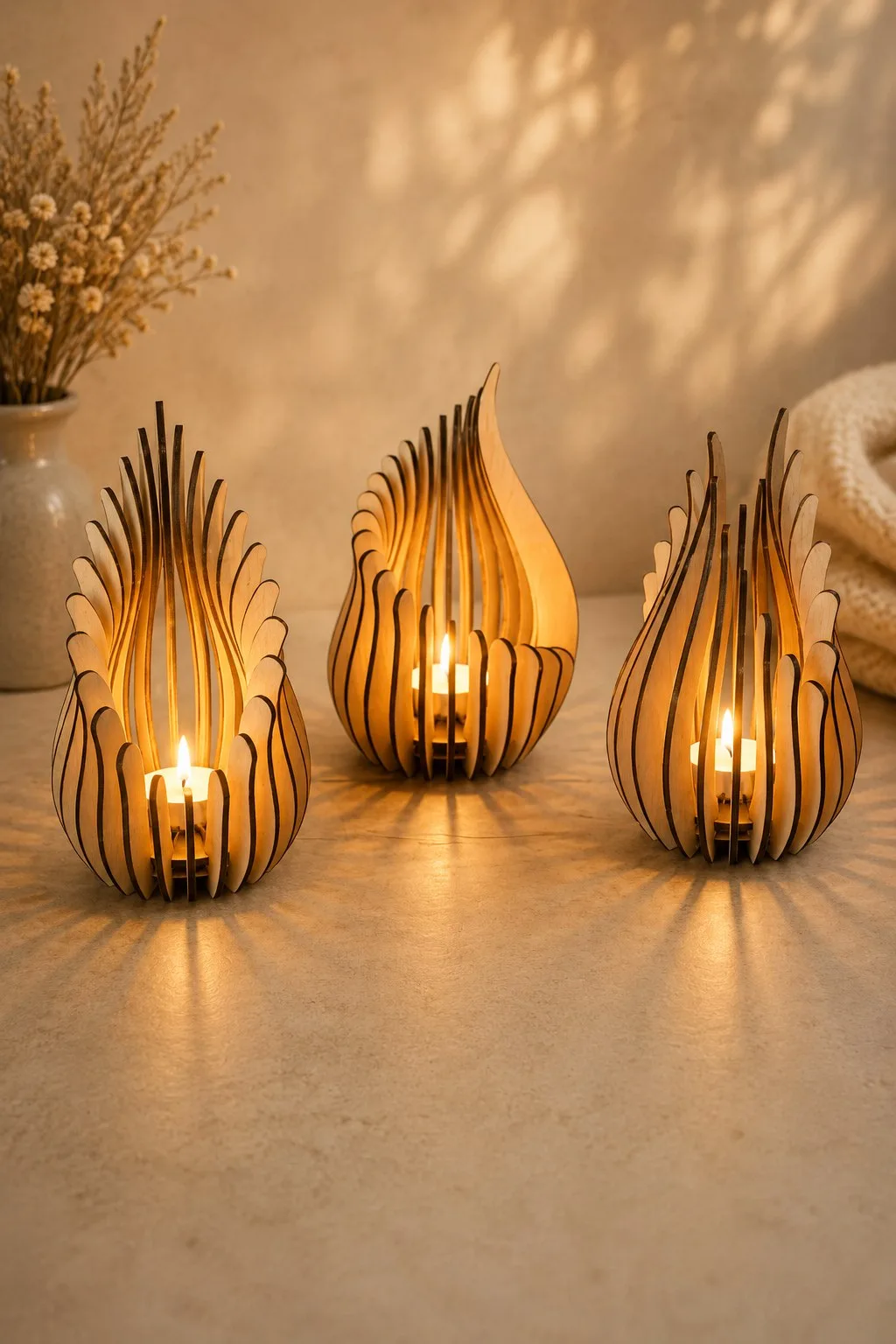
The tallest shape here: the ribs fan out and curl, and the silhouette reads as a tongue of fire. Their edges are shaped rather than straight, so the shadow on the wall comes out serrated instead of striped.
Three variants in the set. Tab-and-slot assembly with no glue, for 3 mm plywood or MDF. The maker names the machines it was tested on: Glowforge, xTool and OMTech.
Fretwork lanterns
Here the candle sits inside a closed body and the light comes out through a cut pattern. The shadow arrives as a picture rather than as bands.
Tall Leaf Lanterns
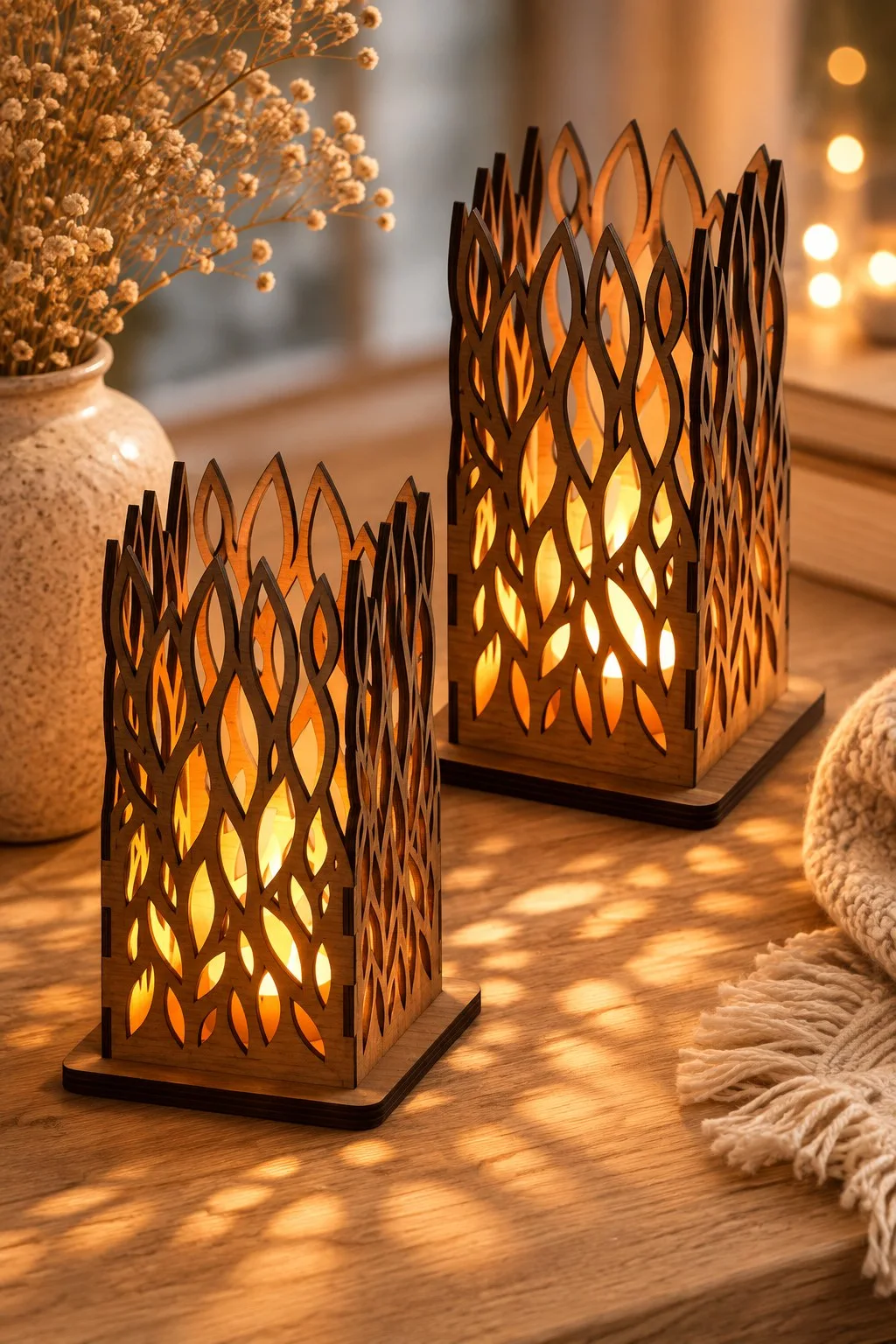
Two narrow lanterns on their own bases, walls filled with elongated leaves almost to the top. Of everything here these throw the largest pattern onto a wall, purely because of the height and the size of the openings.
Assembled size is 160 mm tall on an 80 by 80 base. Four thicknesses and an assembly video, as with the rest of this maker’s files.
Four Small Lanterns
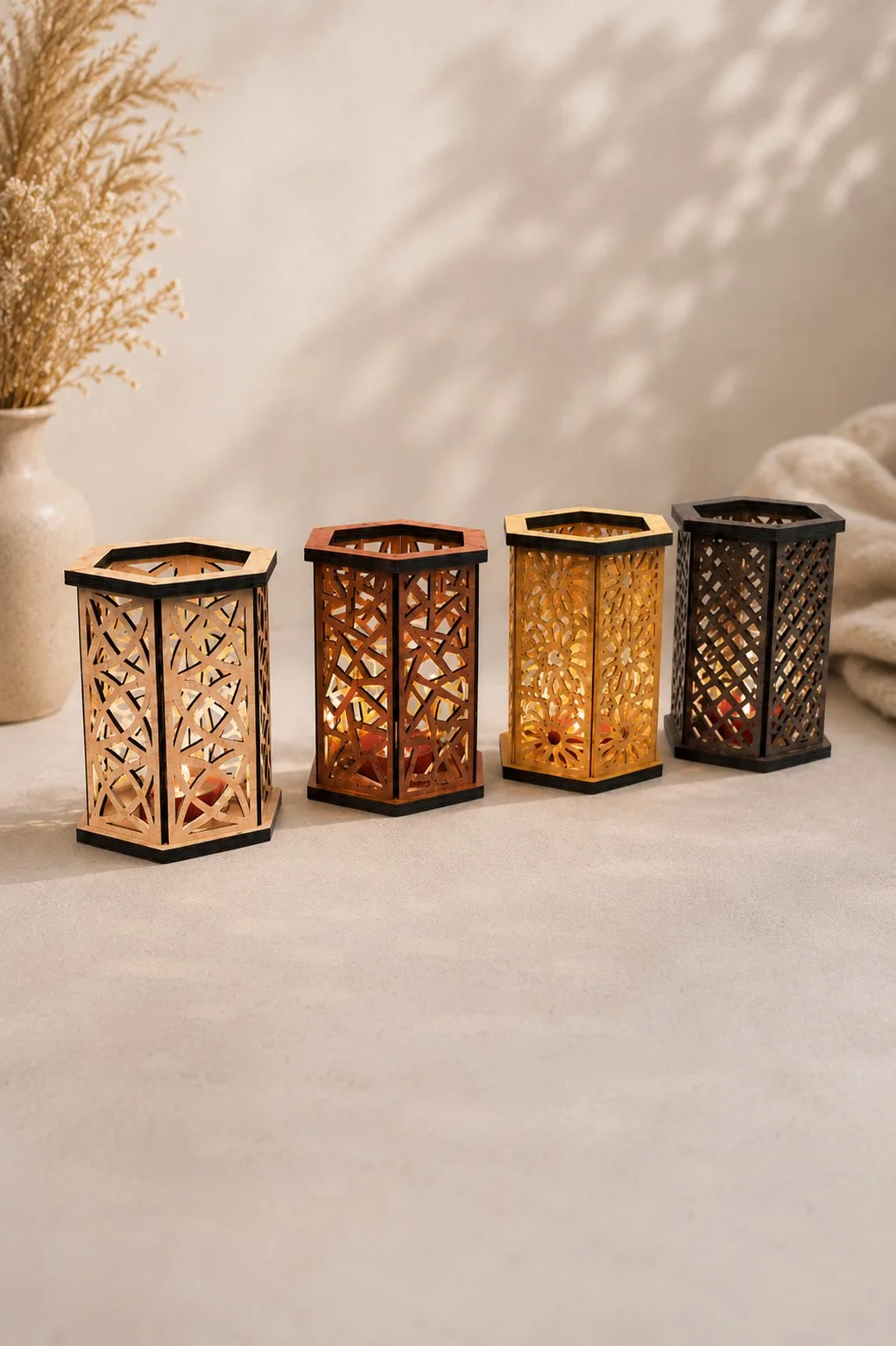
Compact faceted bodies with dense fretwork on every wall, four of them in the set. One gives you a pool of light; four in a row give a continuous pattern across the whole wall.
Size is 10 by 10 by 12 cm, for 3 to 4 mm material. The maker adds a useful note: if you are cutting in LightBurn, use the DXF rather than the SVG.
Selling the finished pieces is allowed; reselling the file is not.
Square Lantern on Legs
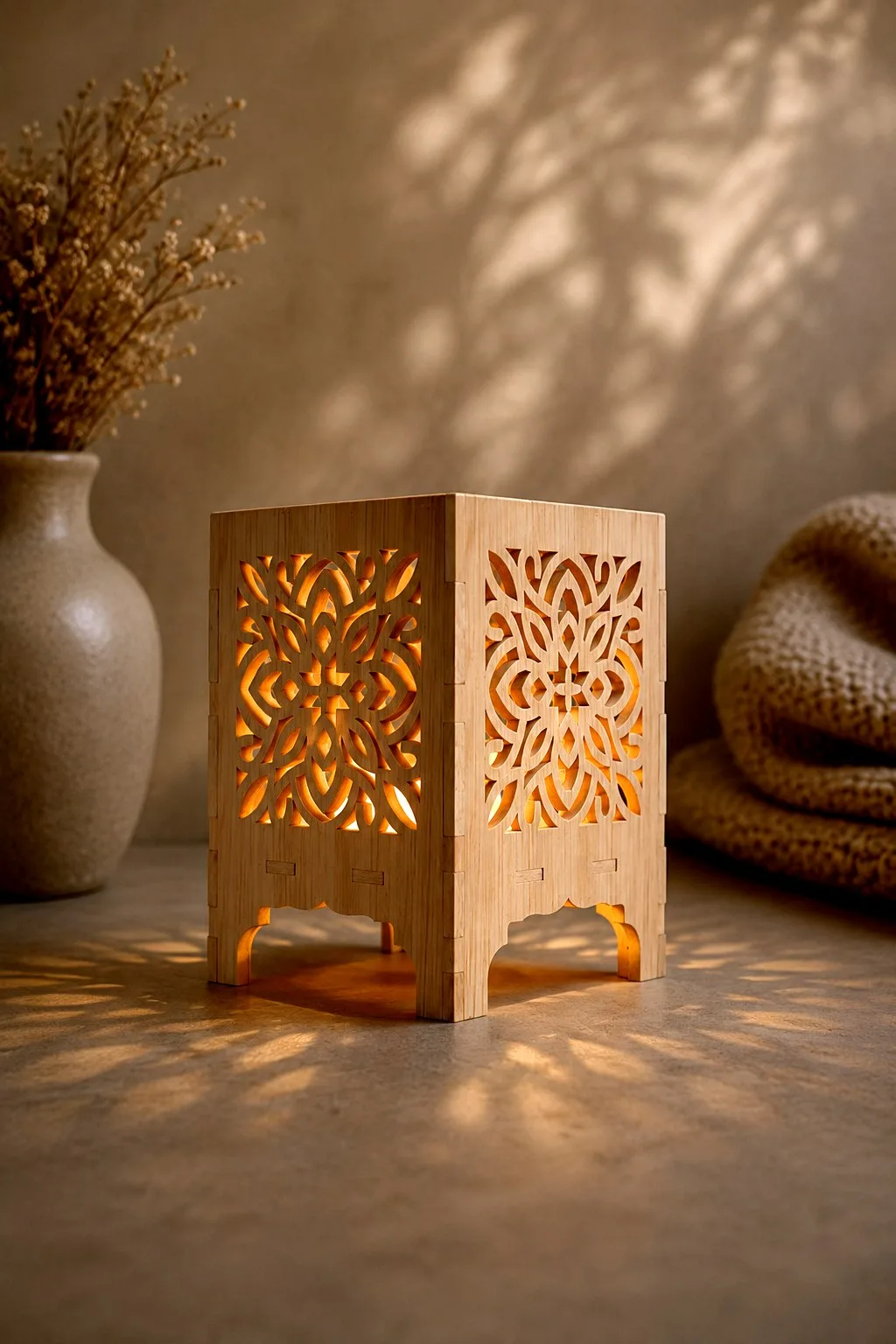
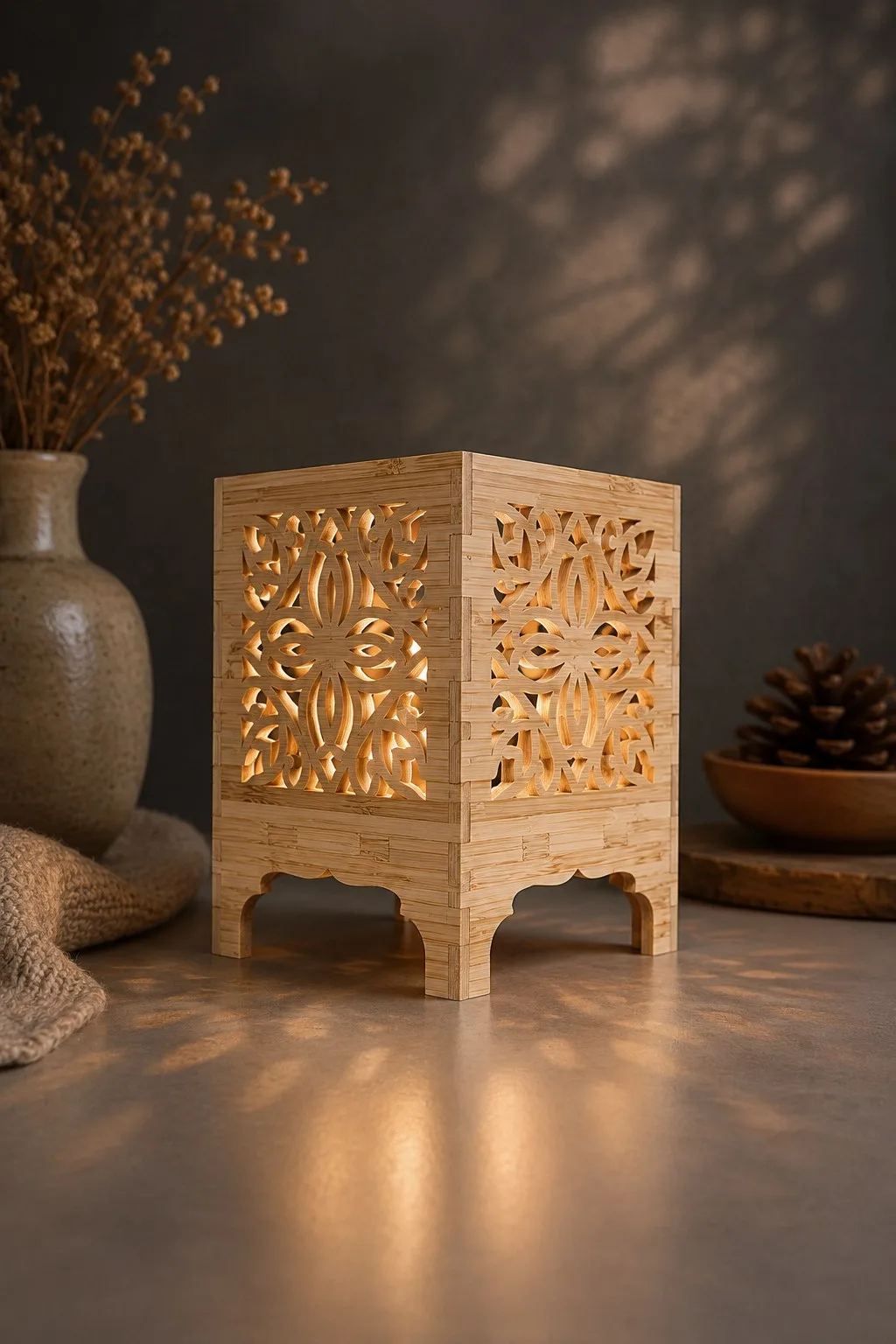
The most furniture-like piece in the set: four carved walls, raised legs, an open bottom. Because of the legs light escapes downwards too, and the lantern reads as hovering over the table rather than sitting on it.
Five different holders come in this file, not one, and the two above are different designs from it rather than two shots of the same box — the panel pattern changes while the body stays the same. Size 156 by 117.5 mm, drawn for 4 mm.
Flower Lanterns
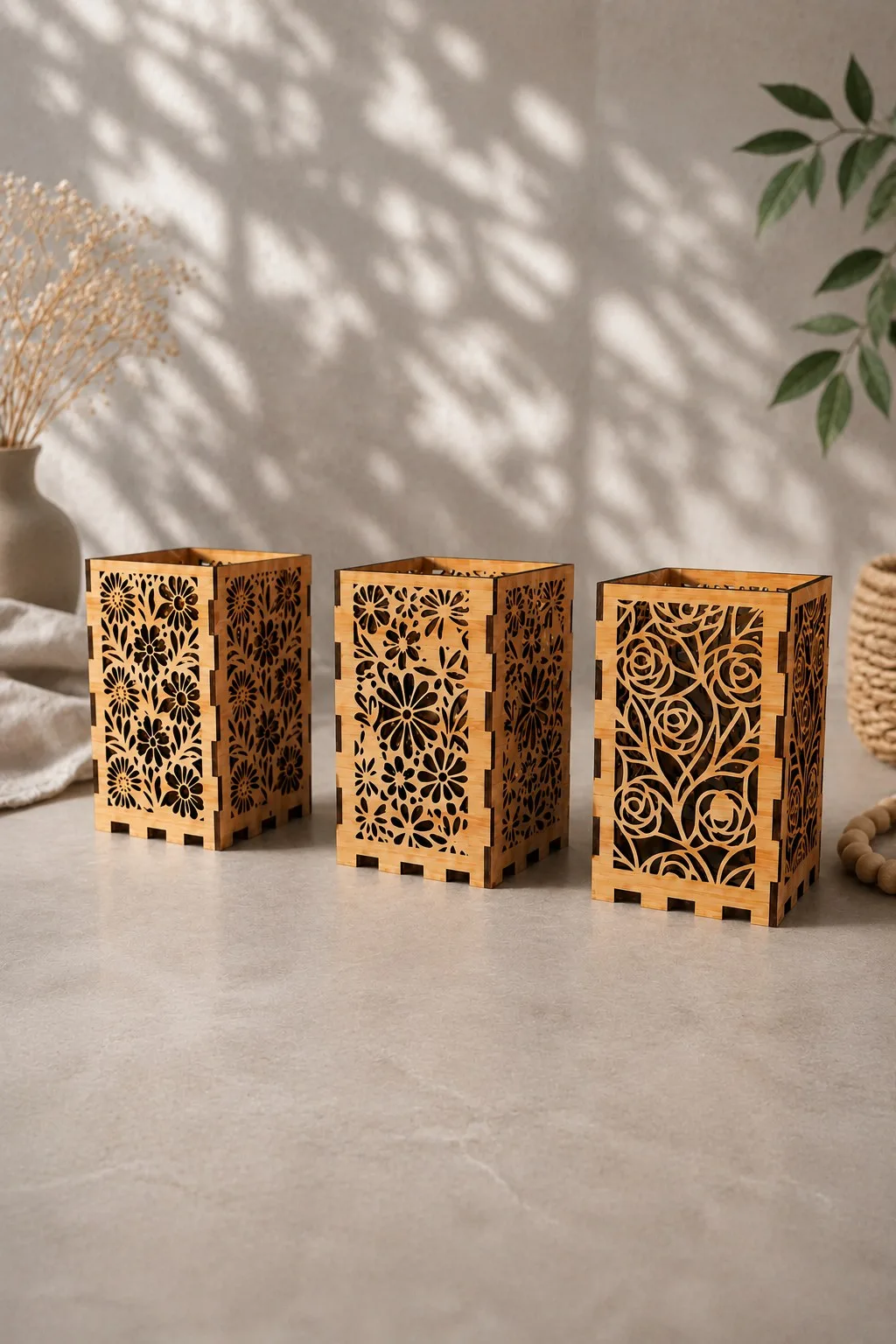
Three square lanterns with different floral panels — daisies, open flowers and climbing roses. The finger joints at the corners are left visible, which is a decision rather than an oversight: the box reads as made rather than moulded.
The fretwork here is the finest in the set, and that is the one to slow down for. Thin webbing burns away easily, so this is a file to test on an offcut before committing a sheet. Drawn for 4 mm; 180 by 100 by 100 mm assembled.
Flat holders
Animal Faces, Ten Designs
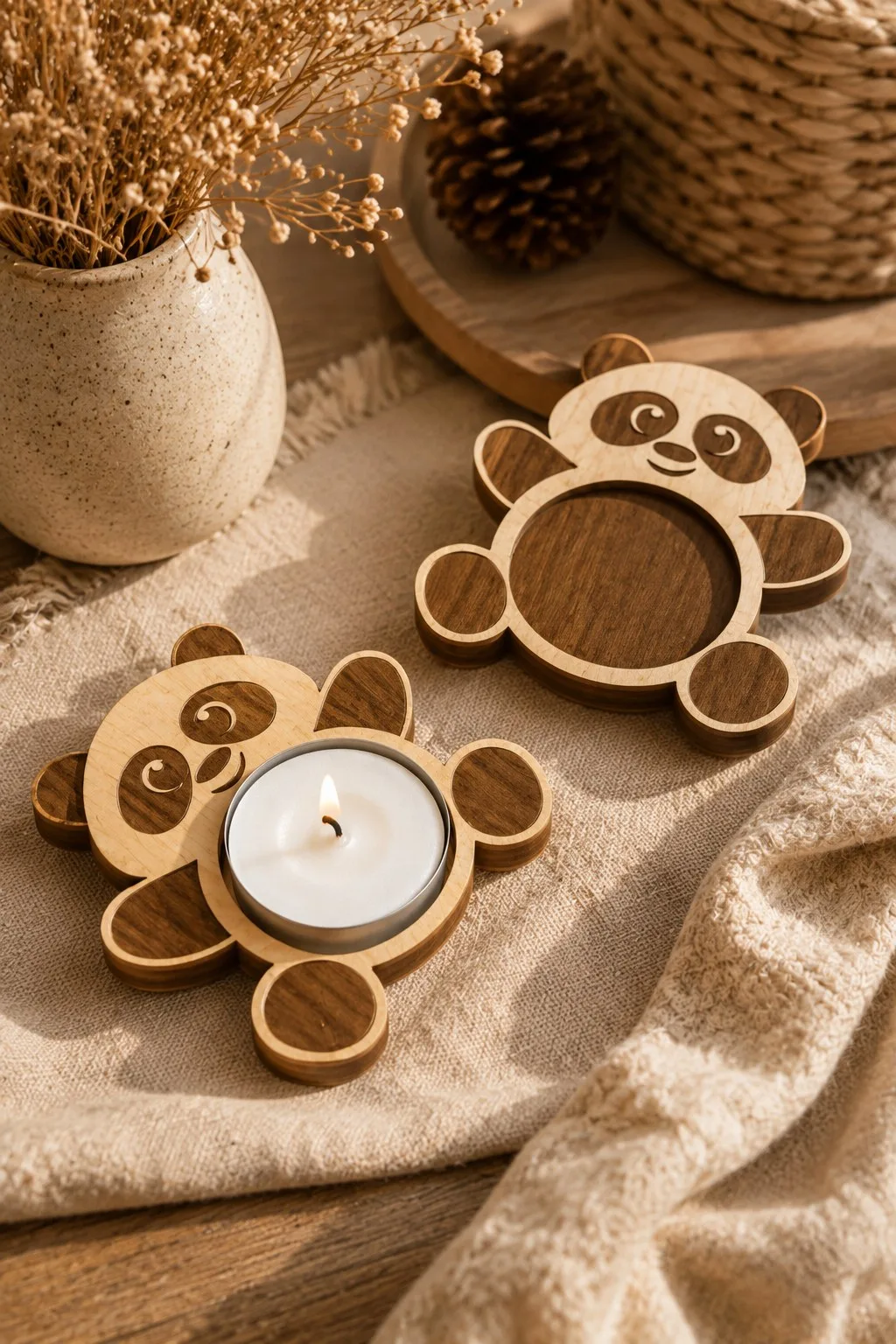
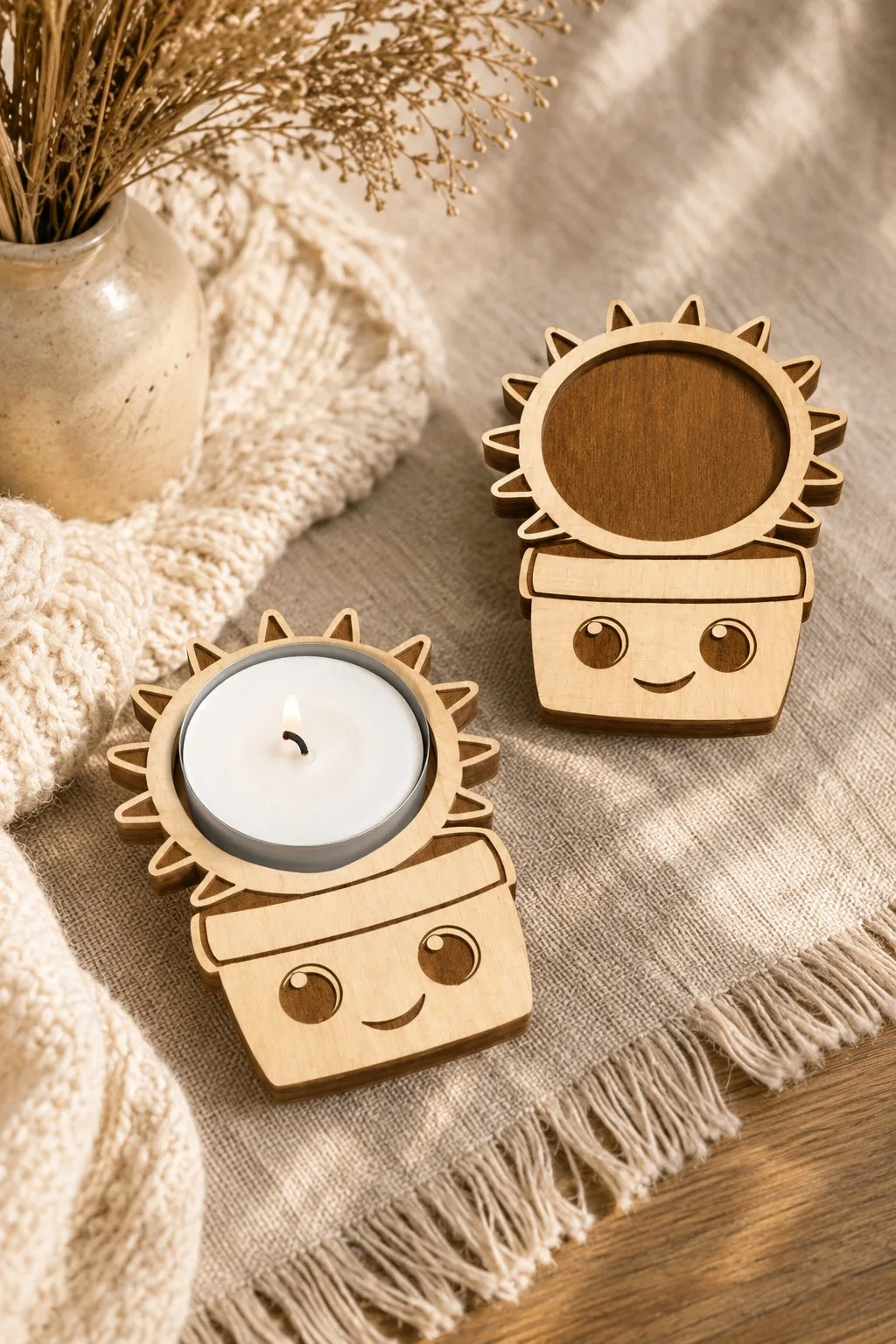
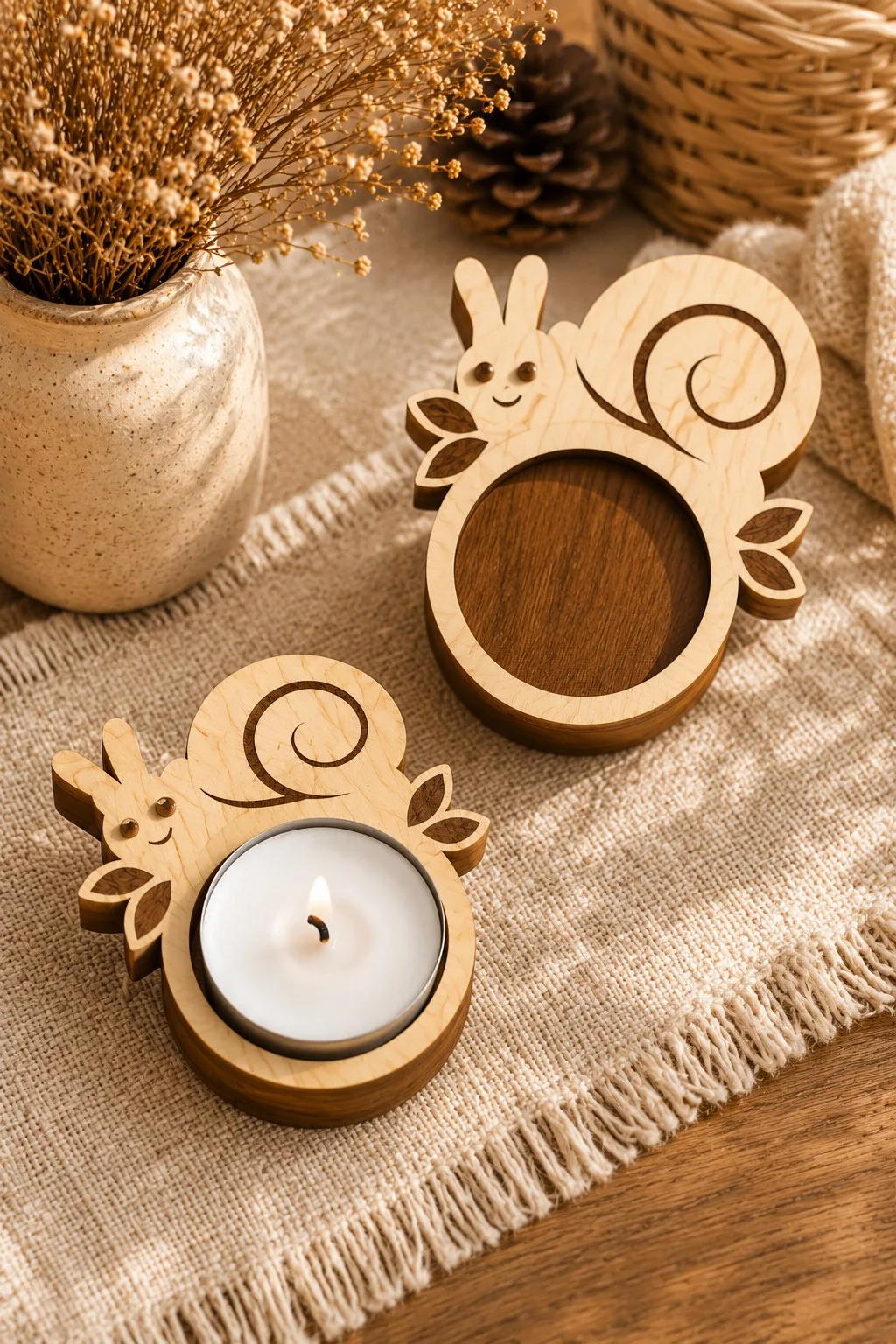
Ten designs: panda, koala, frog, sun, snail and others. A flat base in two or three layers, the bottom solid and the top with a round opening for the tealight. Eyes and smiles are engraved; ears, paws and rays are cut separately and laid on top.
This is the one thing here that is not about light at all. The candle burns in the open and nothing glows through. People take it for the silhouette, not the shadow, and it is a present for a child or a table at a children’s party.
The entry cost is also the lowest of anything on this page: no rings, no slots, no assembly.
Stepped Hexagons for Two Candles
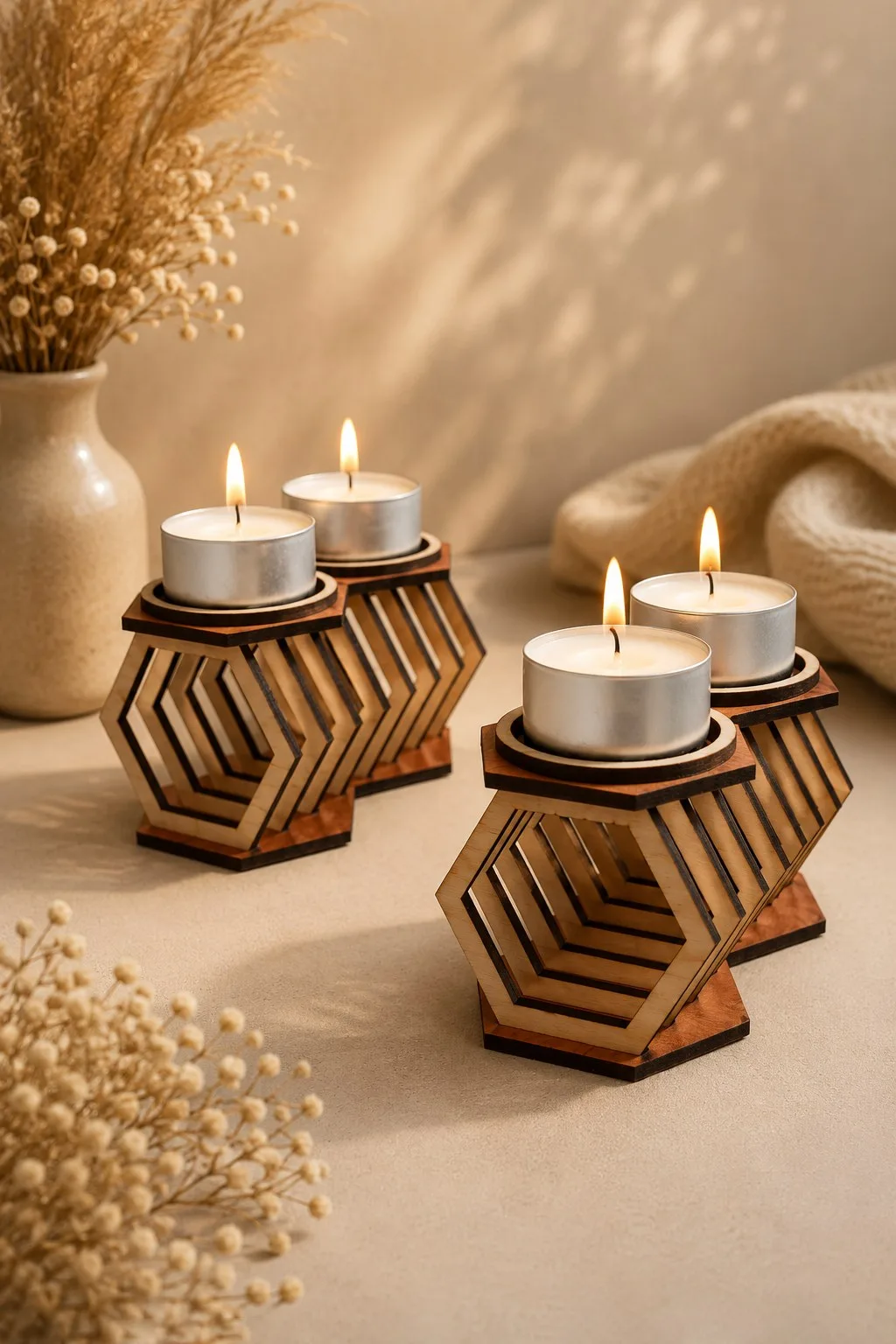
Stepped hexagonal bases, each holding two candles at different heights, with a geometric pattern running round the rim.
The difference in height is the whole point: side by side they build into an arrangement, while a single one just looks ordinary. For 3 mm material, wood or acrylic, eight formats in the archive.
What to know before you cut
Do not resize an assembled design. This is the rule for anything built from parts. Scale a file up or down and the joints stop meeting: the material thickness does not change with your scaling, but the slot width does, so the tab no longer fits it. One of the makers on this page says it in the listing, and it is true for all of them.
Check the scale before cutting. Somebody else’s SVG often opens at the wrong size, because different programs read the units in the file differently. If the maker included a reference square, measure it. If not, measure a part whose size you know and compare it against the listing.
Use an electric candle. In an open piece like the lotus a real tealight still has somewhere to send its heat. Inside a closed lantern the walls are right there. An LED candle also leaves no soot on the inner faces, and that soot never comes off.
Thin is tempting and thin breaks. In anything that glows there is always the urge to make the webbing finer, because more light gets through. The general rule is that the thinnest element should not be thinner than the sheet you are cutting from. On 3 mm plywood a 1.5 mm bridge simply burns away.
If you keep coming back for files
Everything on this page downloads free, and it stays free. But if you notice you are back for a fifth or a sixth file, the arithmetic changes.
Creative Fabrica runs an All Access plan that opens the whole library rather than one file at a time: fonts, graphics, 3D SVG, needlework patterns and the classes as well. It is €4.99 a month billed yearly — €59.88 for the year against €348 at the normal rate.
The part that matters if you sell at a market or a craft fair: the plan includes commercial and print-on-demand use, so the pieces you cut from those files are yours to sell.
More light
Ideas on the same theme, with examples and variations: Laser Cut Luminary & Candle Holder Ideas.
The rest of the free file catalogue is here.
Can’t find the design you need?
Describe your idea in a few words and generate your own SVG design with AI.
Good to know: the files in this guide are hosted on Creative Fabrica. Downloading is free with their free trial: a payment card is needed to start it, and you can cancel the subscription at any time.