Santa & Advent Calendar SVG: Wooden Laser Cut Templates
Most Christmas laser files hang on a tree and do nothing. An advent calendar has a job: someone opens a drawer every morning for twenty-four days, and by the time it is empty the tree is up. That also changes when you cut it. A calendar goes on the machine in early November, not the week before Christmas, because it has to be finished before the first of the month.
Below are the wooden advent calendars we have, all built around the same grid of little drawers, and then the Santa pieces that sit with them: the ticket that starts the morning, the height chart on the wall, and the sleigh under the tree.
Short answer: for a calendar with real drawers, the Santa Mail post box, cut from 6 mm. For a countdown with nothing to refill, the tree with a number dial or the countdown bauble. For a calendar that is also a toy, the train. For a child’s name, the Nice List tickets and the Santa Meter. All twelve side by side: jump to the comparison table.
File details are based on the designers’ product descriptions on Creative Fabrica.
Ways to count the days
Santa Mail, twenty-five drawers
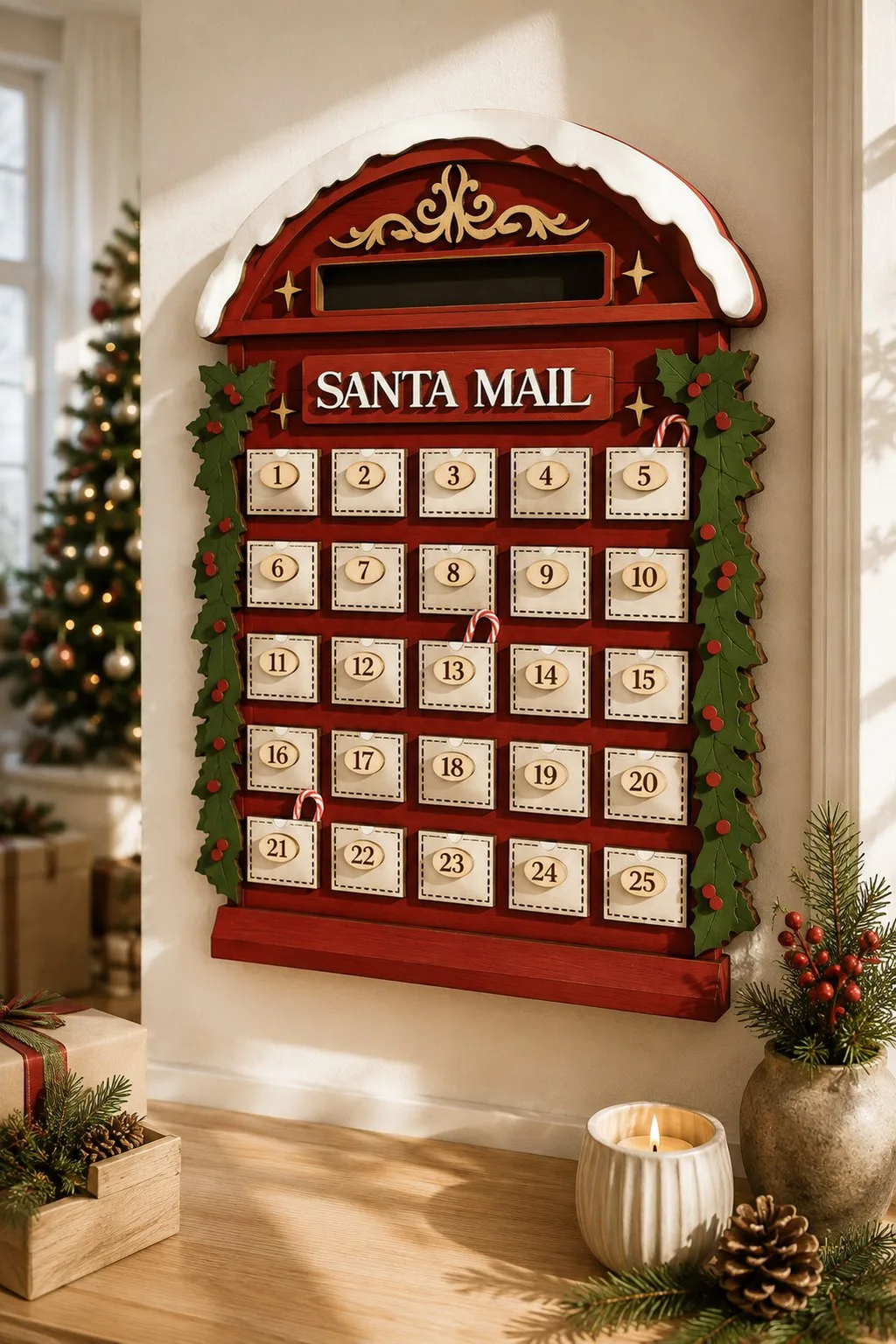
A red post box with an arched top, a letter slot and a name board under it. Five rows of five drawers, numbered 1 to 25 on little oval plaques, with holly garlands down the sides and a narrow shelf along the bottom. The drawers actually pull out; in the photo a few have candy canes sticking out of them.
The maker names 6 mm material for this bundle, which is the point worth stopping on: that is twice the usual 3 mm you would use for an ornament. A drawer cut from thin ply flexes and jams. At 6 mm the box holds its shape and the drawers slide.
The same grid, three more shells
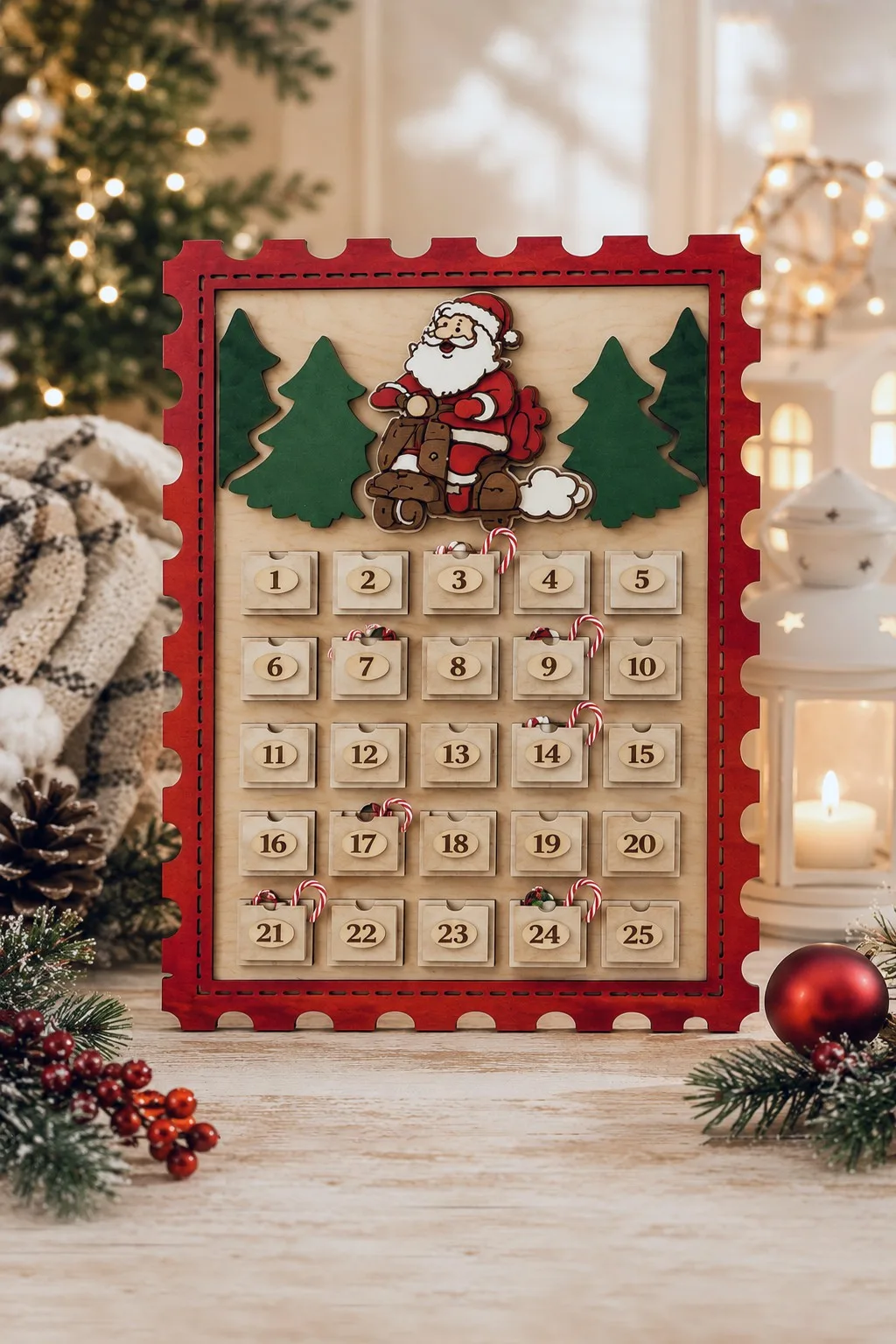
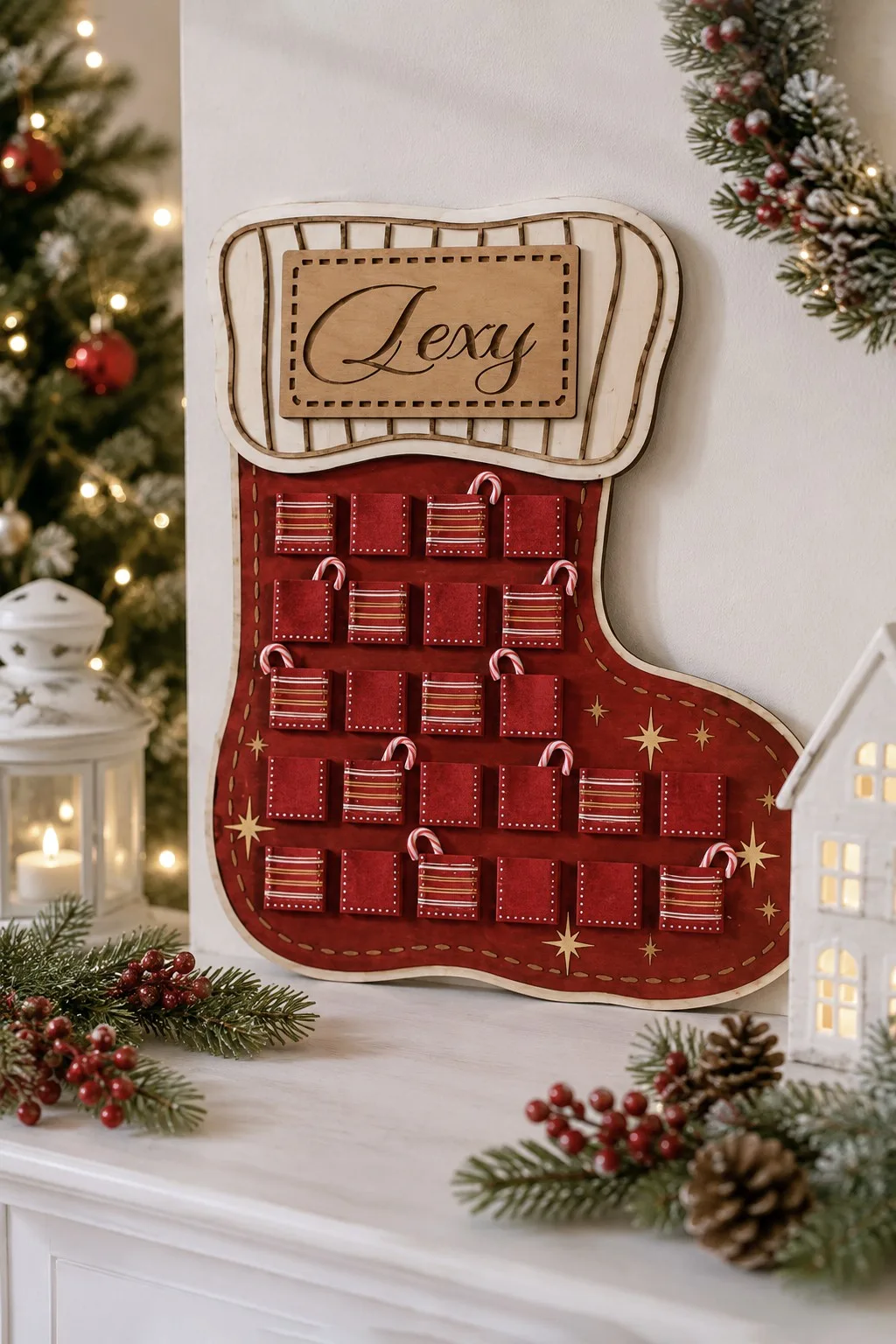
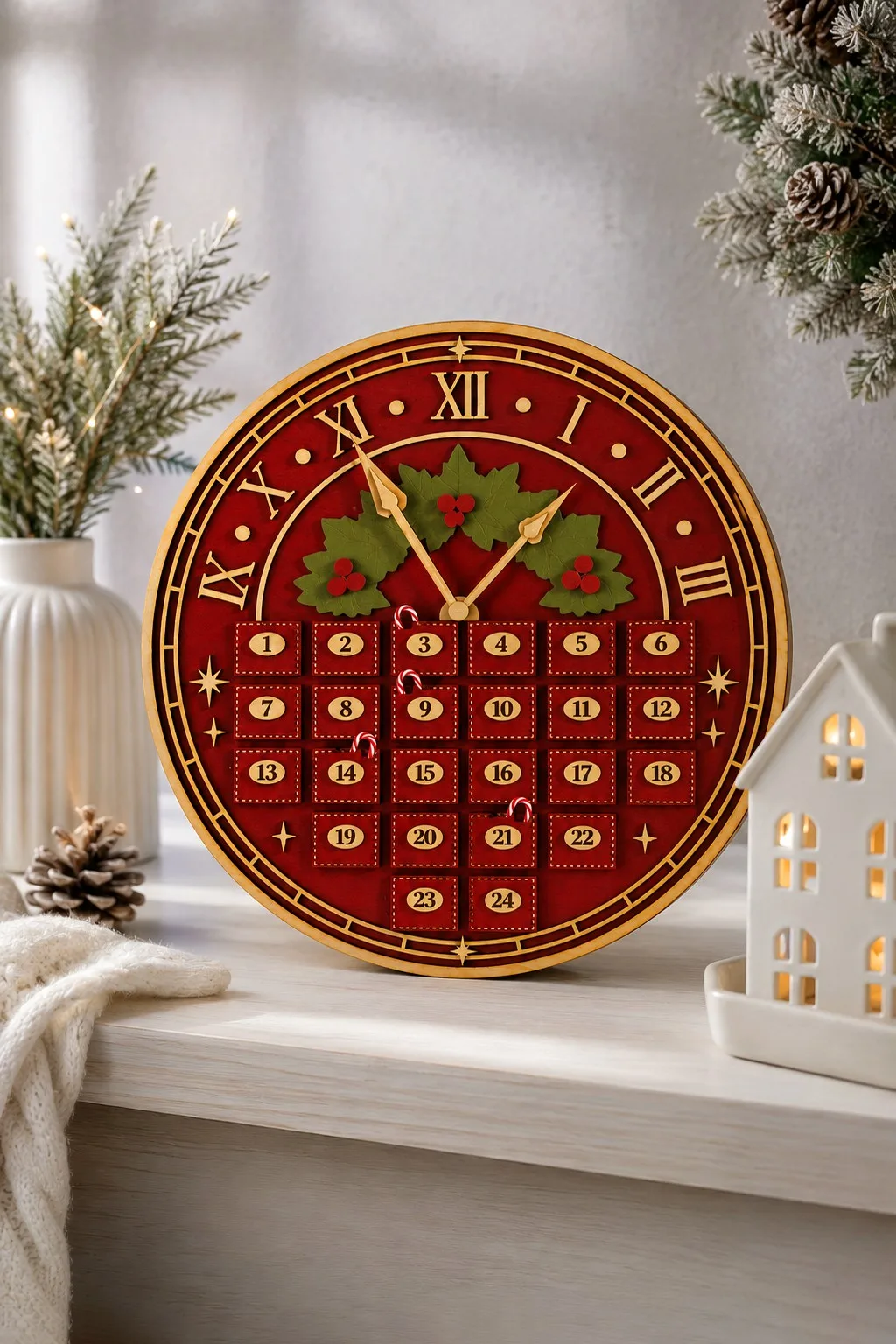
The same drawer mechanism sits behind three other outlines. A postage stamp with a perforated edge and Santa on a scooter across the top. A stocking with a ribbed cuff and a separate engraved plaque for a name, the drawer rows running different lengths as the silhouette narrows to the foot. A clock face with Roman numerals round a gold rim, hands stopped just before twelve, and the drawers filling the lower half of the circle, the last row only two wide.
The bundle has ten designs in all; four are shown here. It comes as SVG, DXF, EPS, PDF, JPEG and PNG. One purchase, and you can cut a different calendar every year without drawing anything.
A bauble that counts the days down
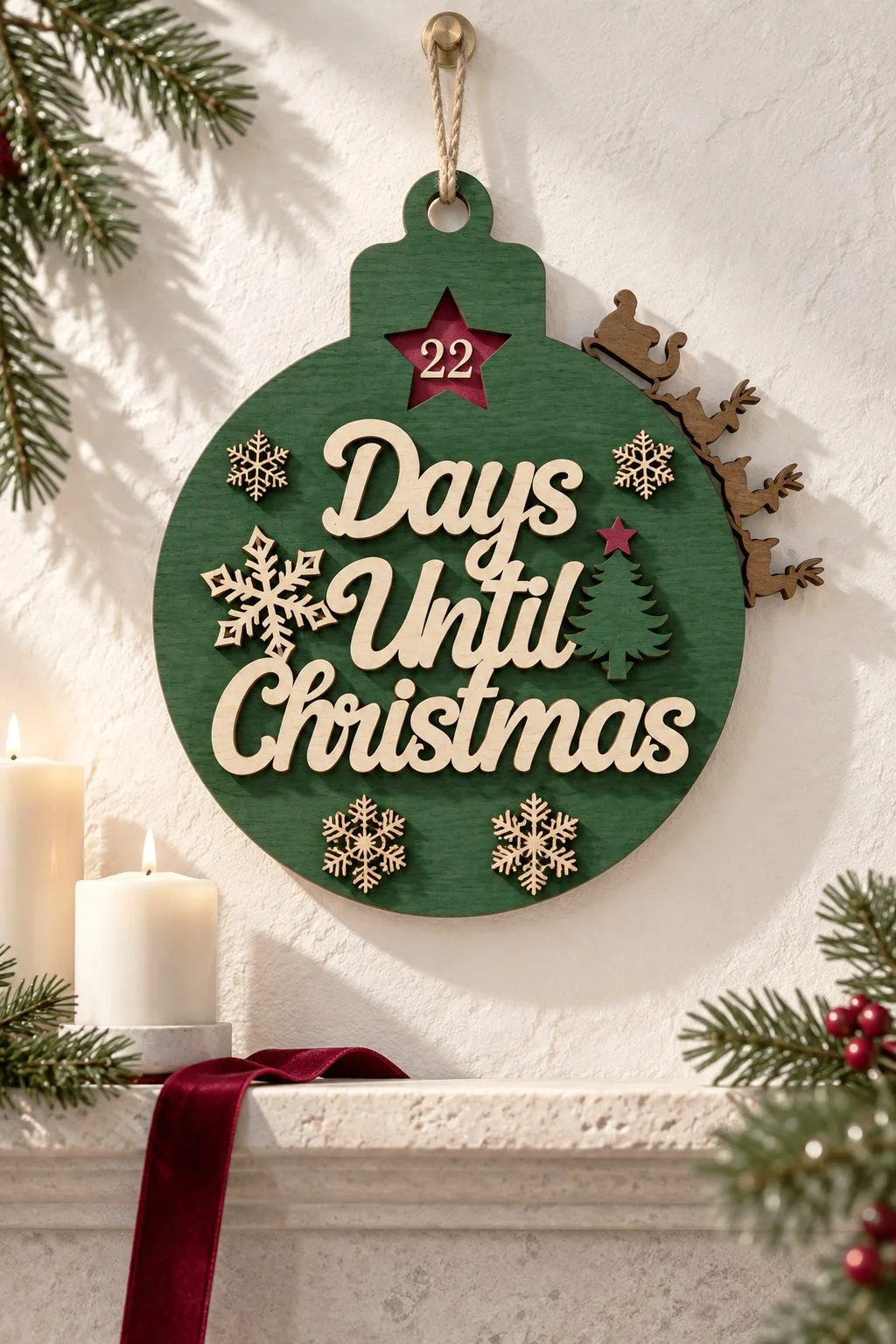
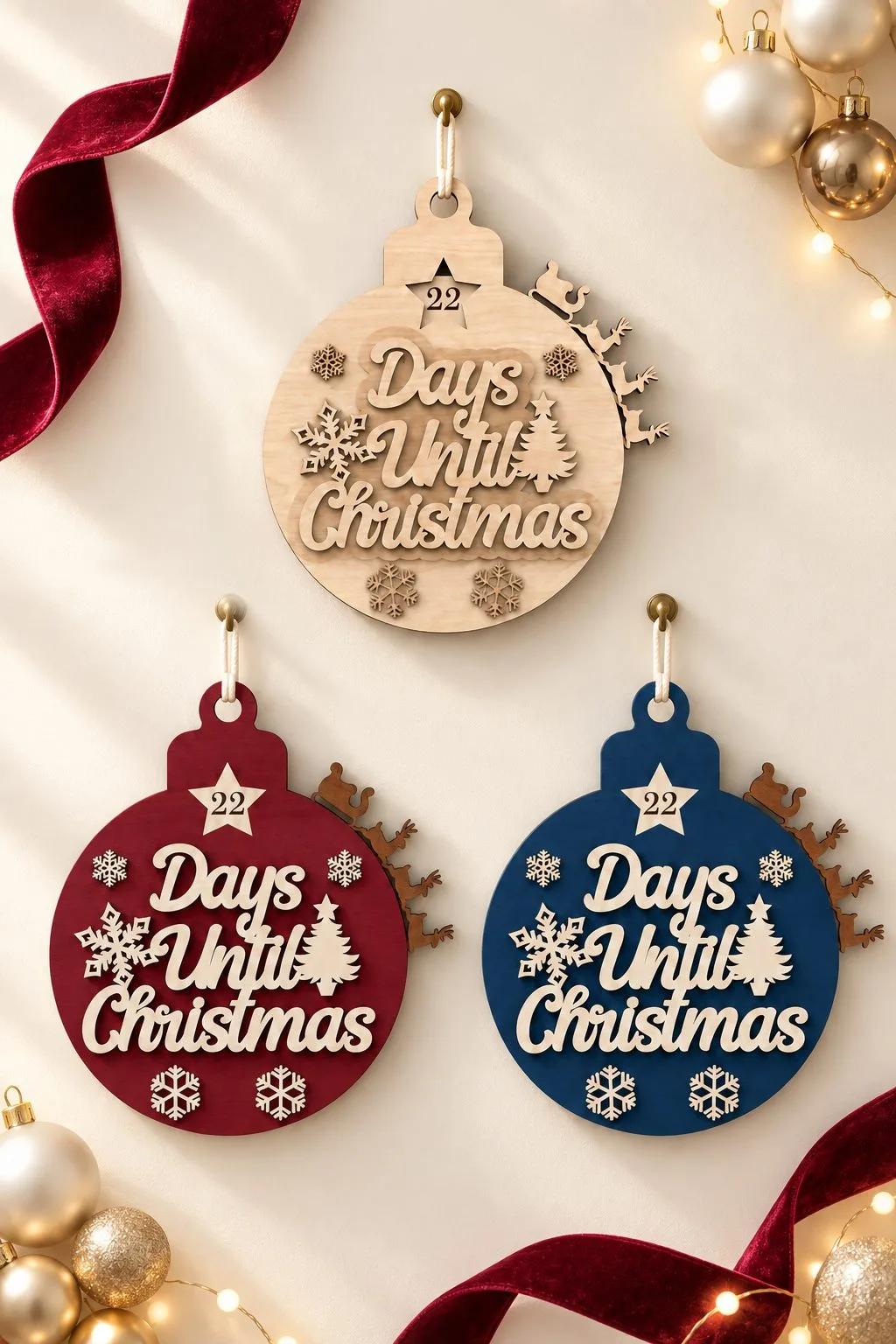
The counting happens in the star at the top: one number shows through it, and Santa’s sleigh and reindeer run around the rim below. About 19 cm tall by 15 cm wide, cut in three layers of depth.
It is built to be assembled rather than hung as-is — the listing includes picture instructions, and the maker specifies 3 mm plywood, MDF or acrylic for the layers. Stain the disc and leave the lettering and snowflakes in bare wood and one file covers a whole shelf of them, as the natural, red and blue set here shows.
Files come as AI, EPS, DXF, PDF and SVG. One design in the bundle.
A dial you turn instead of a drawer you open
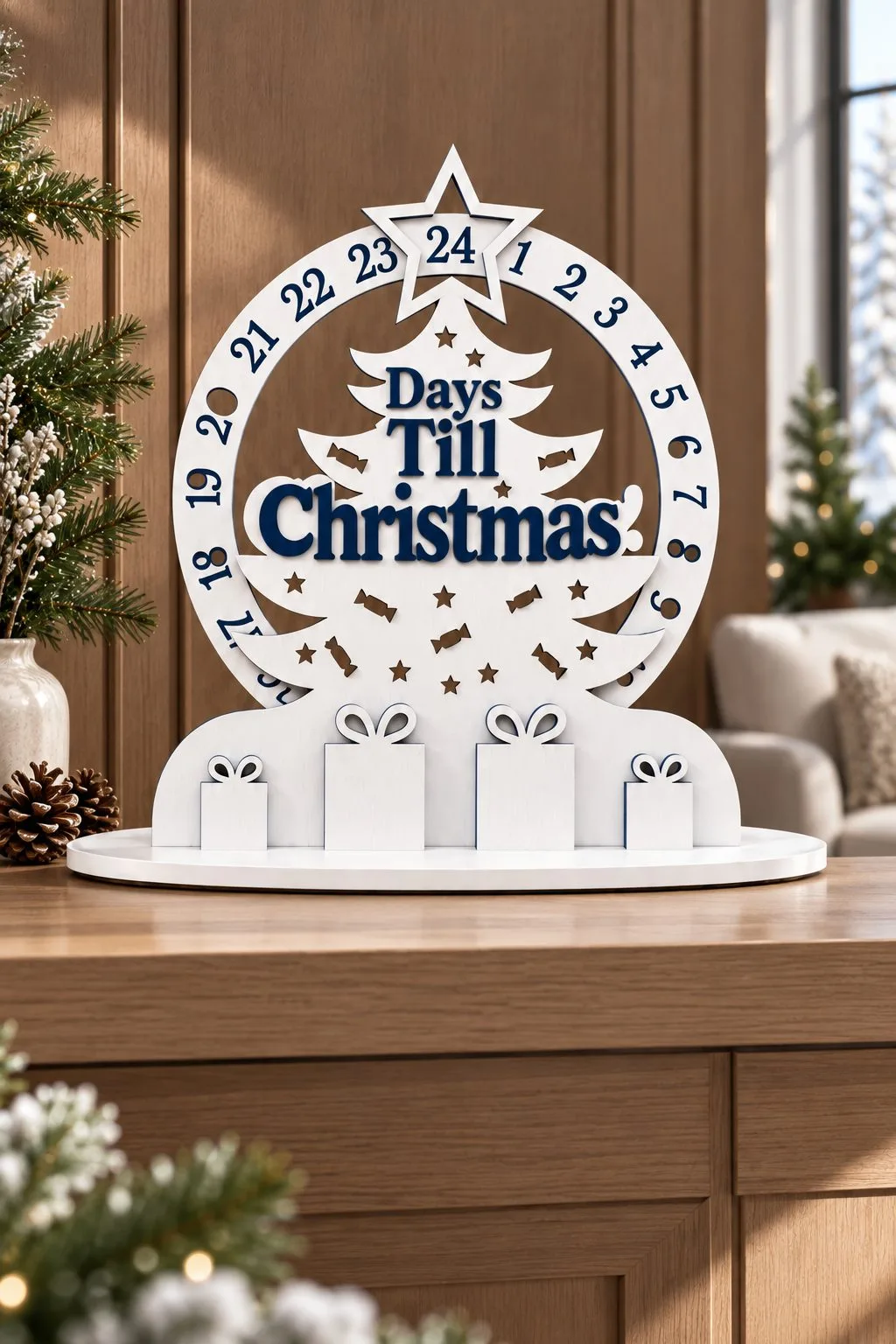
A wheel of numbers from one to twenty-four turns behind a cut-out tree, and the star at the top frames a single number, so the days left are the only thing showing. The Days Till Christmas lettering sits raised on the tree with candies and stars scattered around it, and four little gift boxes stand along the oval base.
Nothing gets opened and nothing needs refilling, which is the version that survives a house where the sweets in a drawer calendar never last to the fourth of December.
The parts slot together without glue, assembly notes come with the files, and thicknesses cover 3, 3.2 and 4 mm.
A train you assemble
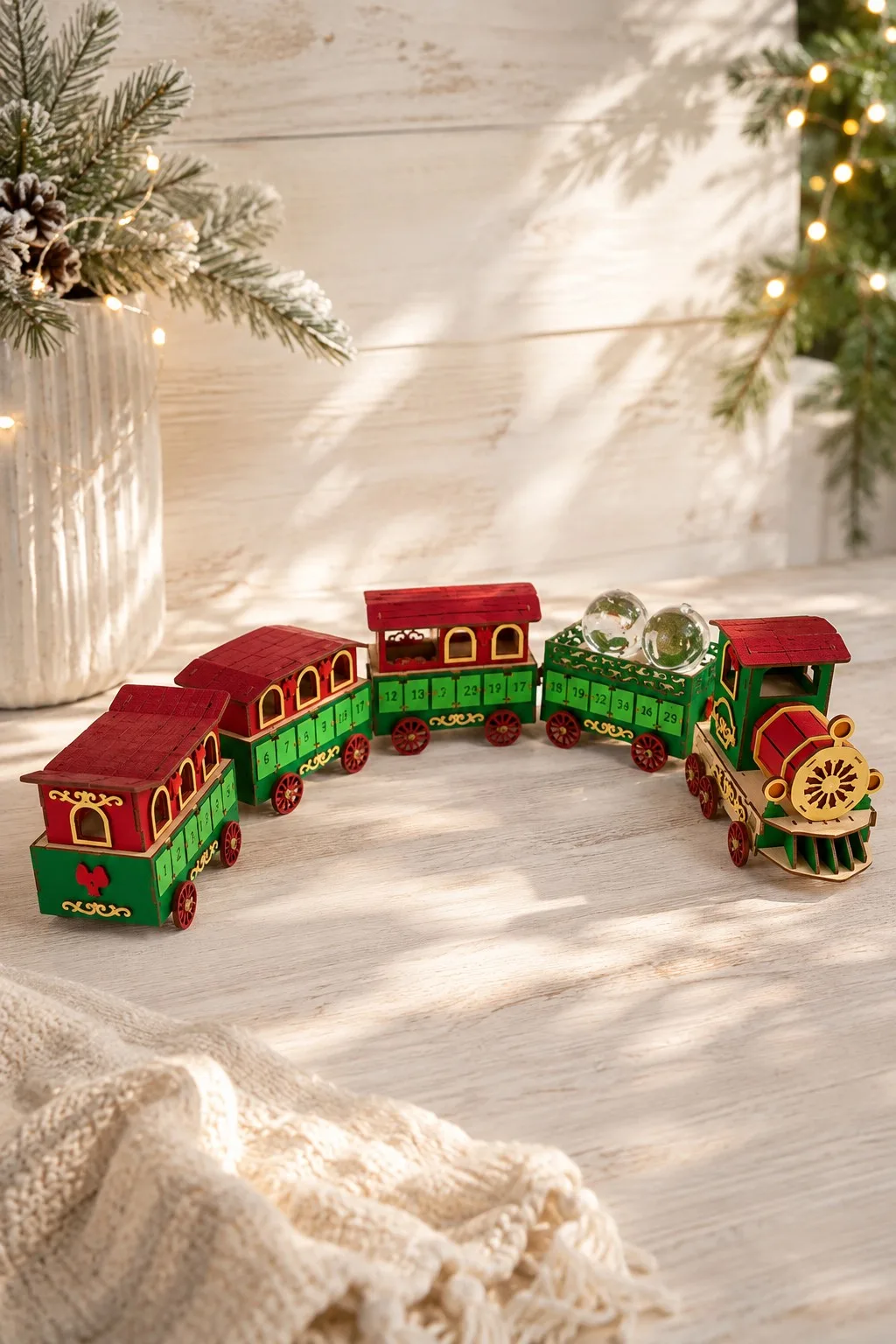
Five pieces that stand in a curve: an engine and four cars, and the sides of the cars are the rows of numbered drawers. The engine has a canopy roof on posts, a gold spoked disc on the front and a toothed cowcatcher below. One car is an open flat wagon with a fretwork rail. The file marks red lines to cut and black lines to engrave, and there are five designs in it, the engine plus four cars.
One note from the maker: LightBurn sometimes distorts the size when it imports the SVG, so in that program take the DXF instead. Among the calendars here, this is the one that reads as a toy rather than a wall piece.
Straight from Santa
Nice List tickets

Two tickets cut from pale wood with a notched edge down both sides, so the shape reads as a torn ticket straight away. The top one has a thin frame, a name engraved in lower case, NICE LIST large, then OFFICIAL MEMBER and APPROVED BY SANTA, with a round NORTH POLE stamp in the corner. The lower one is a certificate: the name, YOU MADE IT ON THE NICE LIST, a Santa signature and a postmark. All of the text is engraved, so it cuts in one pass with no letters to glue. The only applied parts are a wooden bow and a snowflake on a jute cord.
This is not a tree ornament, it is a small prop. It gets handed to a child in the morning, which is a different reason to make one than decorating a room.
A Santa Meter that turns
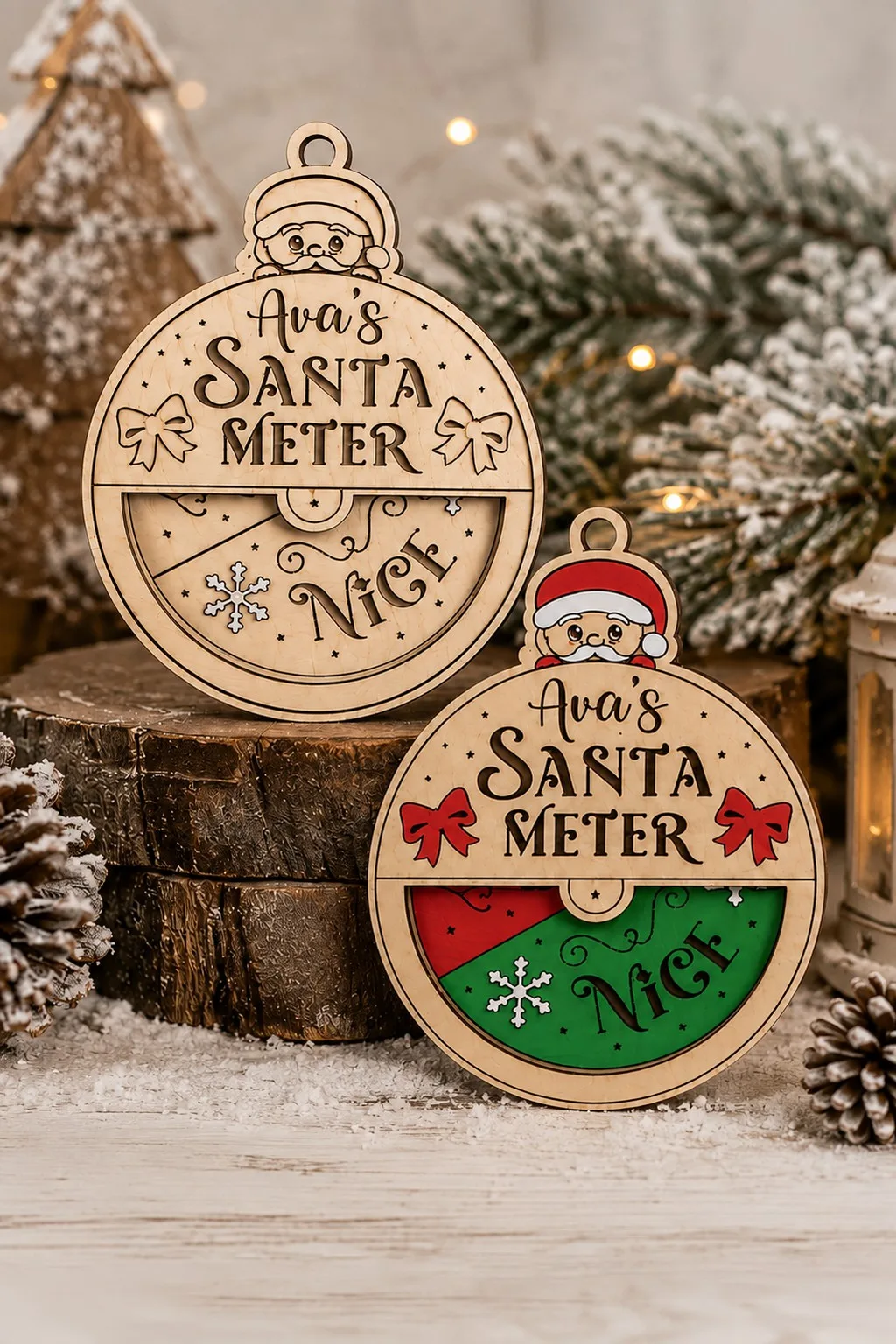
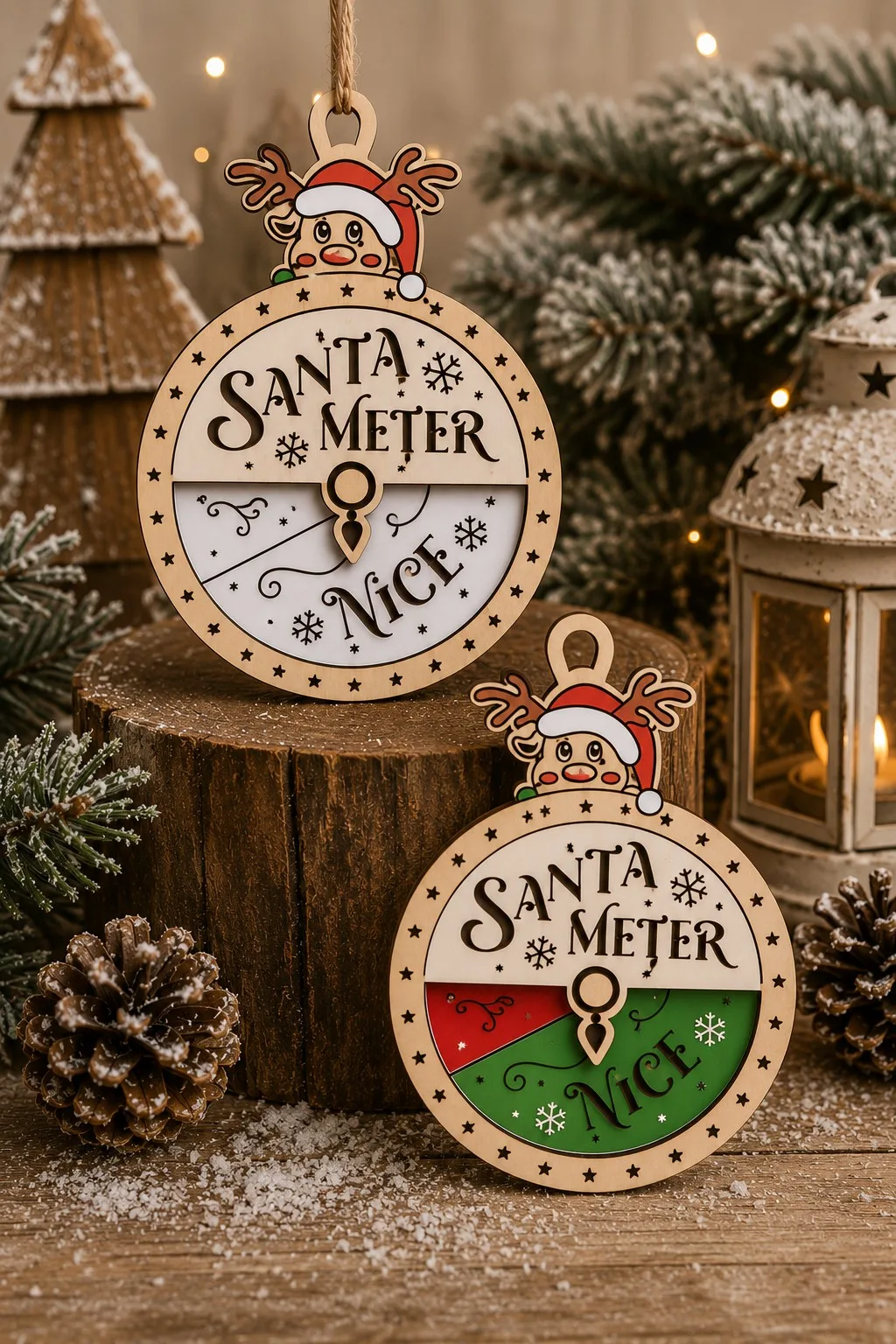
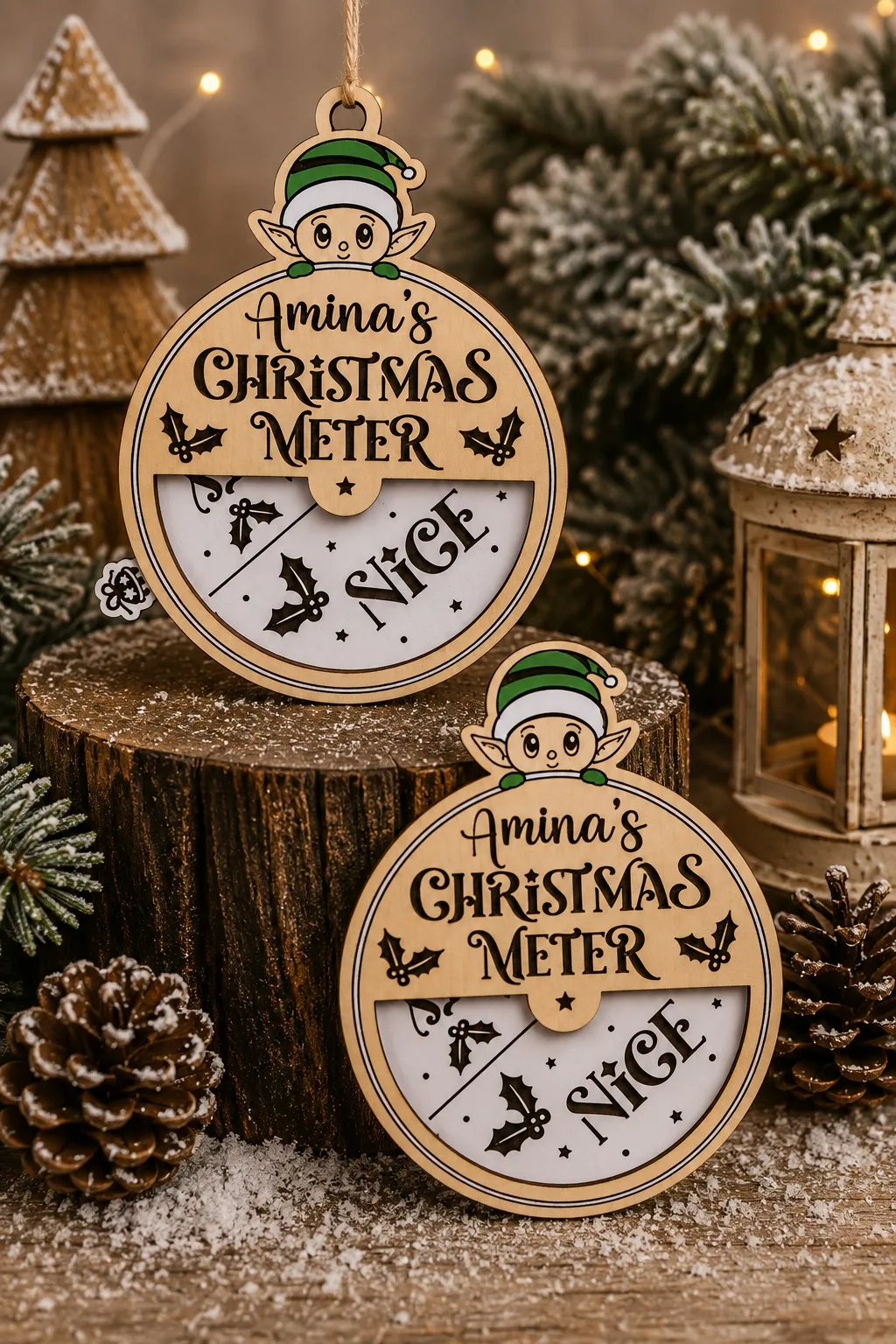
A round ornament with a character’s head peeking over the top edge as a separate piece — Santa on one, a reindeer on another, an elf on a third. The upper half is an engraved panel: a child’s name over SANTA METER, or CHRISTMAS METER where the wording changes, with bows, scrollwork or holly around it. The lower half is a dial behind a cut window, part red, part green, NICE on the green side, and it turns on a rivet at the centre so you move the needle yourself.
That rivet is the whole interest of this one. It is the only design here with a moving part, and a turning joint on a laser piece is just a pin or an eyelet through two holes with a washer between the layers so nothing binds. Each photo shows the piece twice, bare wood beside the painted version, which is the clearest picture in the set of how much the paint does and how little the cut changes. The maker gives ten designs and does not name a thickness; keep the moving layers thin so the dial swings freely. The name is engraved, so there is a file per child.
The alphabet in Santa hats

Every letter of the alphabet as its own ornament, with a small Santa hat sitting on the top corner and hanging over the edge. The hat is three parts, a red crown, a white band and a round pom pom. The letter is light wood over a dark backing that shows as a shadow line all the way round, and a name is engraved in fine script down the side. The hanging hole is part of the shape and takes red and white twine.
One letter per child, or a family’s initials in a row along the mantel. The maker covers A to Z.
What goes under the tree
A sleigh you fill with sweets
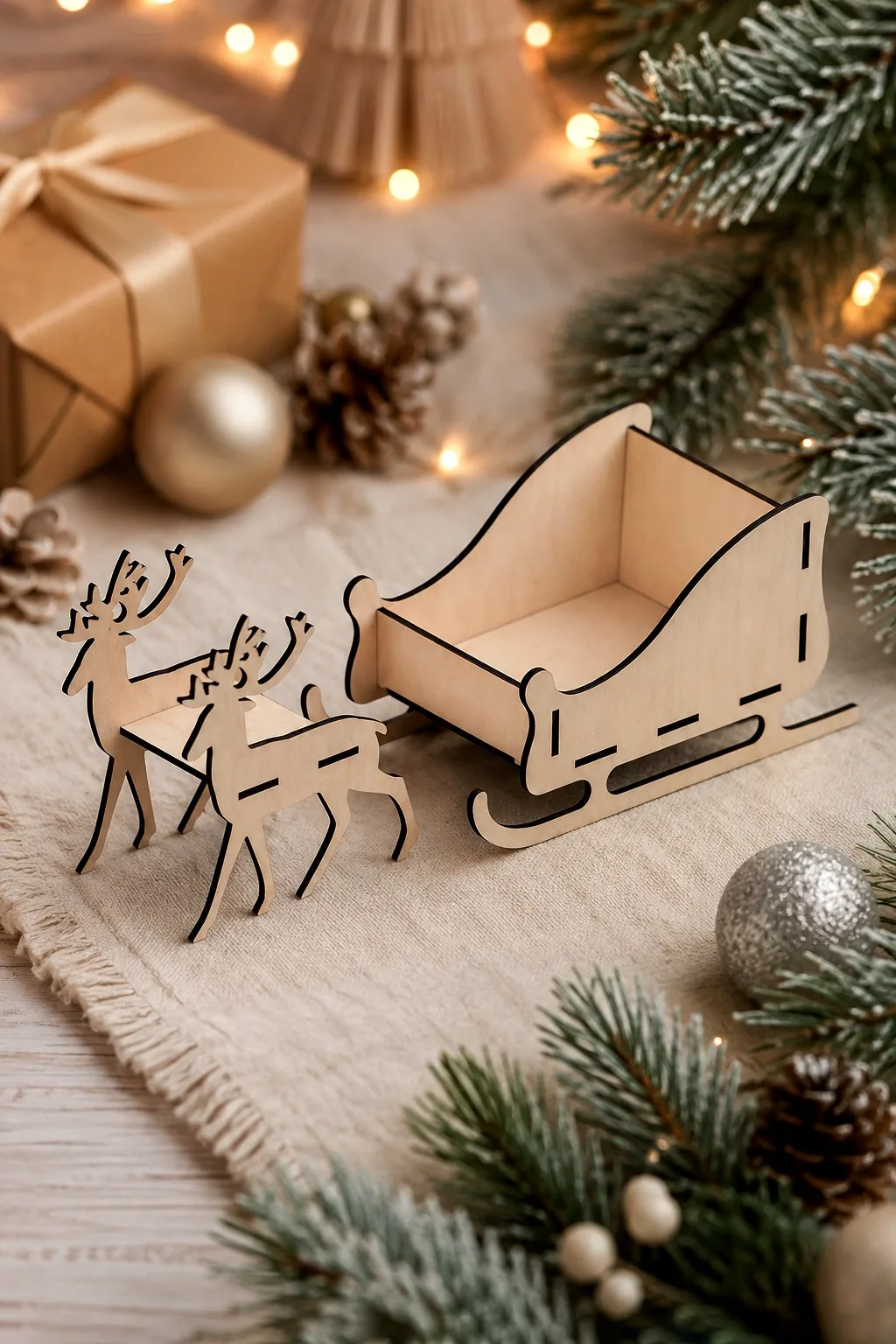
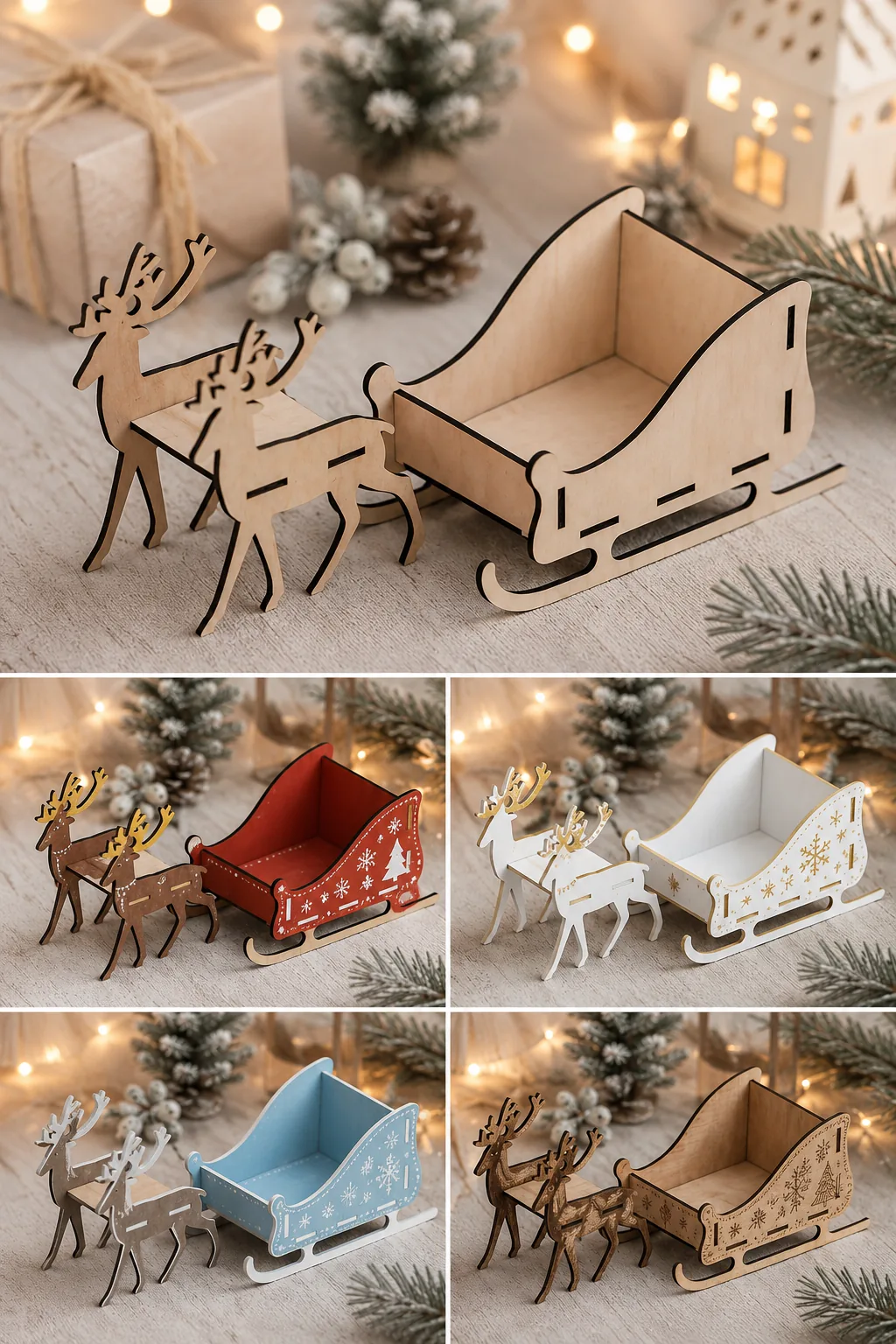
An open sleigh with a high curled back, a floor, two sides and runners with a turned-up nose, all going together on slots with no glue. The box inside is empty, so it holds sweets, small gifts, a candle or a little plant. Two flat reindeer stand on their own legs, joined to the sleigh by a straight bar that keeps the team in one line.
The maker’s second photo is a collage: the bare assembly on top, then the same model painted four ways underneath. Same cut, very different objects.
A whole reindeer team
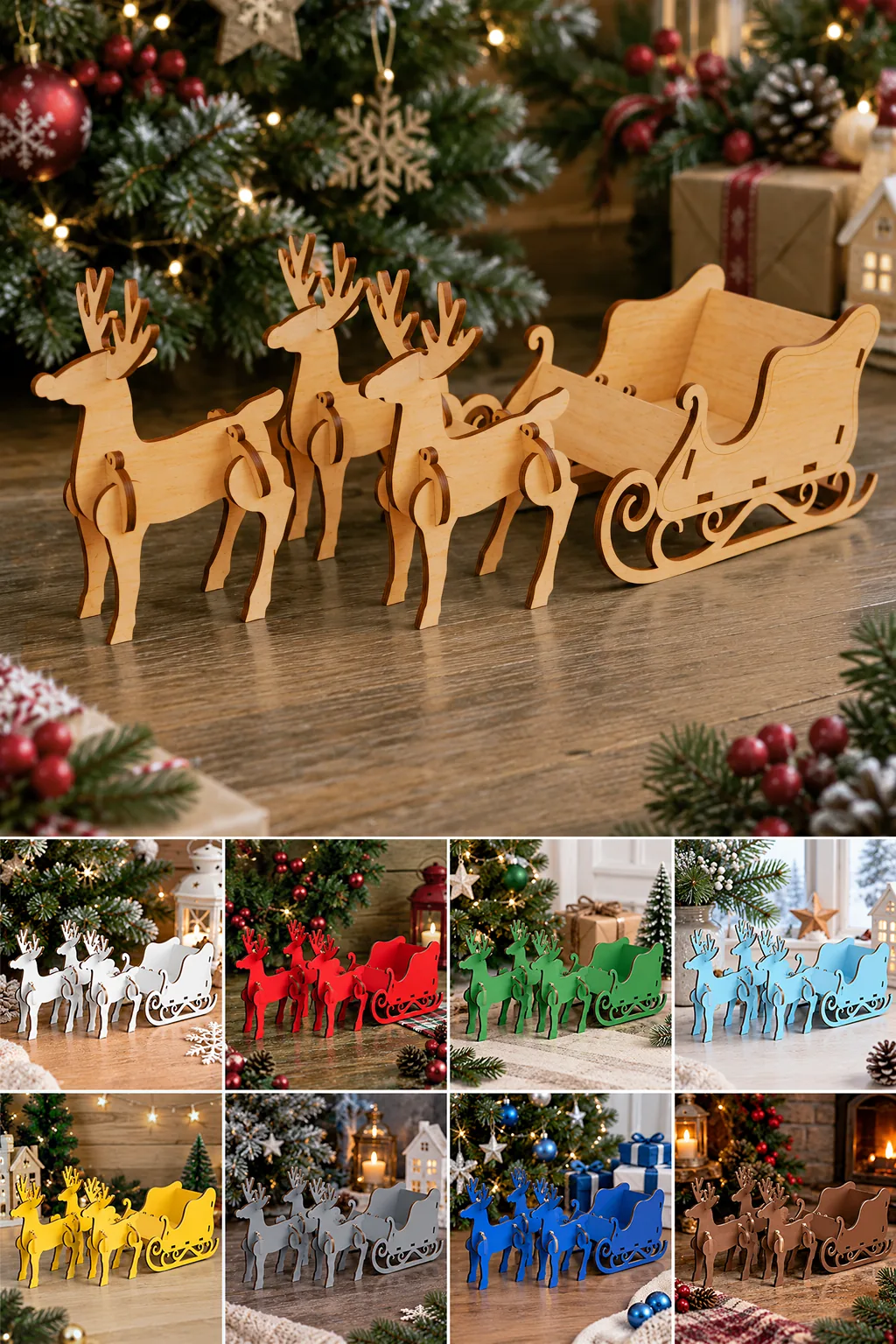
A different take on the same idea, and the one that grows. The reindeer is about 10.5 cm long and 14 cm tall, it stands on its own base, and you cut as many as you want and line them up. Each one has holes in the sides for a cord that acts as the reins, and the sleigh has two holes in the front to hook onto the team. The sleigh itself is about 20 cm long with a hollow box for sweets.
The maker gives real sizes, which lets you plan the space: four reindeer plus the sleigh is over half a metre in a row, so it wants a long shelf or a mantel, not a side table. Thicknesses listed are 3 mm, 3.2 mm and 4 mm, and there is a plain-nose body and a red-nose one for Rudolph at the front.
A Christmas village you line up on a shelf

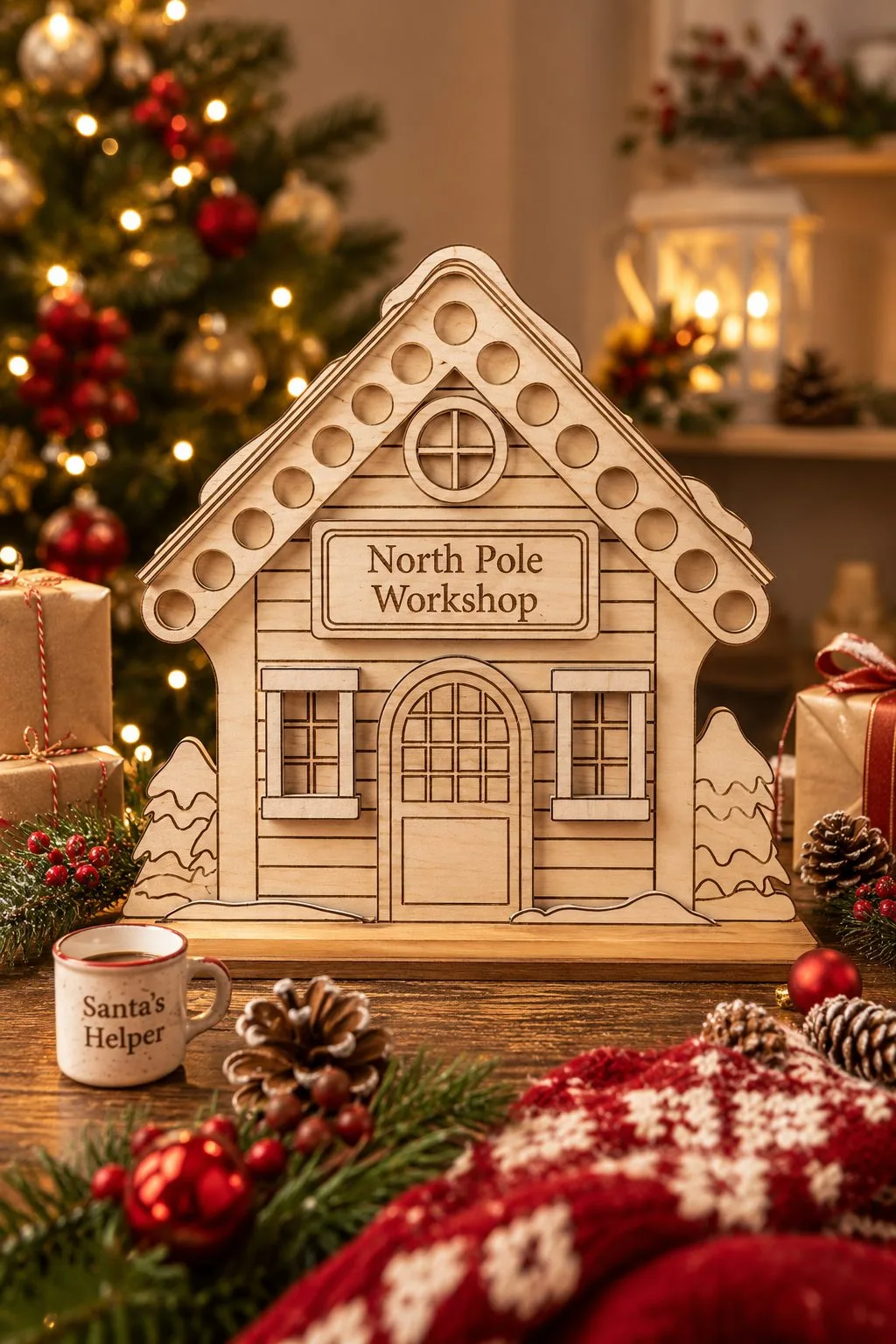
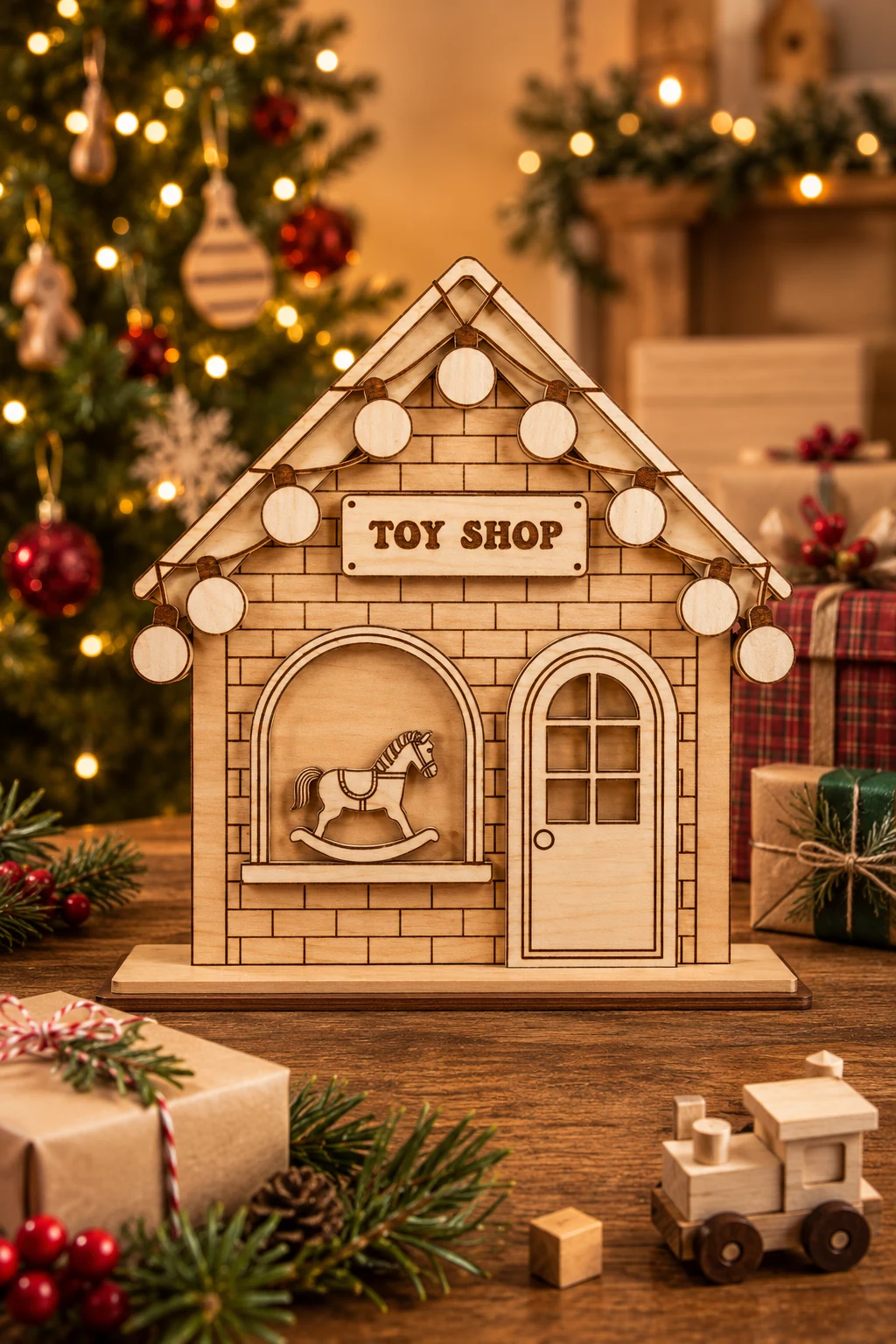
Four layered houses in one download, inspired by cozy Christmas streets, with a toy shop, a North Pole workshop and festive winter cottages among them. Each one is a flat house front on its own rectangular stand, so they line up on a mantel like a street. Three of them are in the photos. The first has white snow with a wavy, dripping edge along the roof, a brick chimney, a heart in the gable and windows under little snow hoods. The North Pole Workshop keeps to pale plywood, with an engraved sign, a round window above it and a row of round holes along the roof that read as garland bulbs. The Toy Shop has engraved brickwork, a rocking horse in the arched shop window and real round bulbs cut as separate pieces.
The depth comes from overlays rather than from a box: window frames, snow, signs and garlands are laid on top, while the brickwork, siding and glazing bars are engraved. Cut all four and you have a village for the shelf; sell them as a set at a holiday market or one at a time as shelf sitters and gifts. You get one ZIP with four files in each format: SVG, AI, DWG, EPS, DXF and PDF. The seller names plywood or MDF, the machines Glowforge, xTool and OMTech, and LightBurn as compatible software; sizes and thickness are not given.
Round scenes that stand on a box
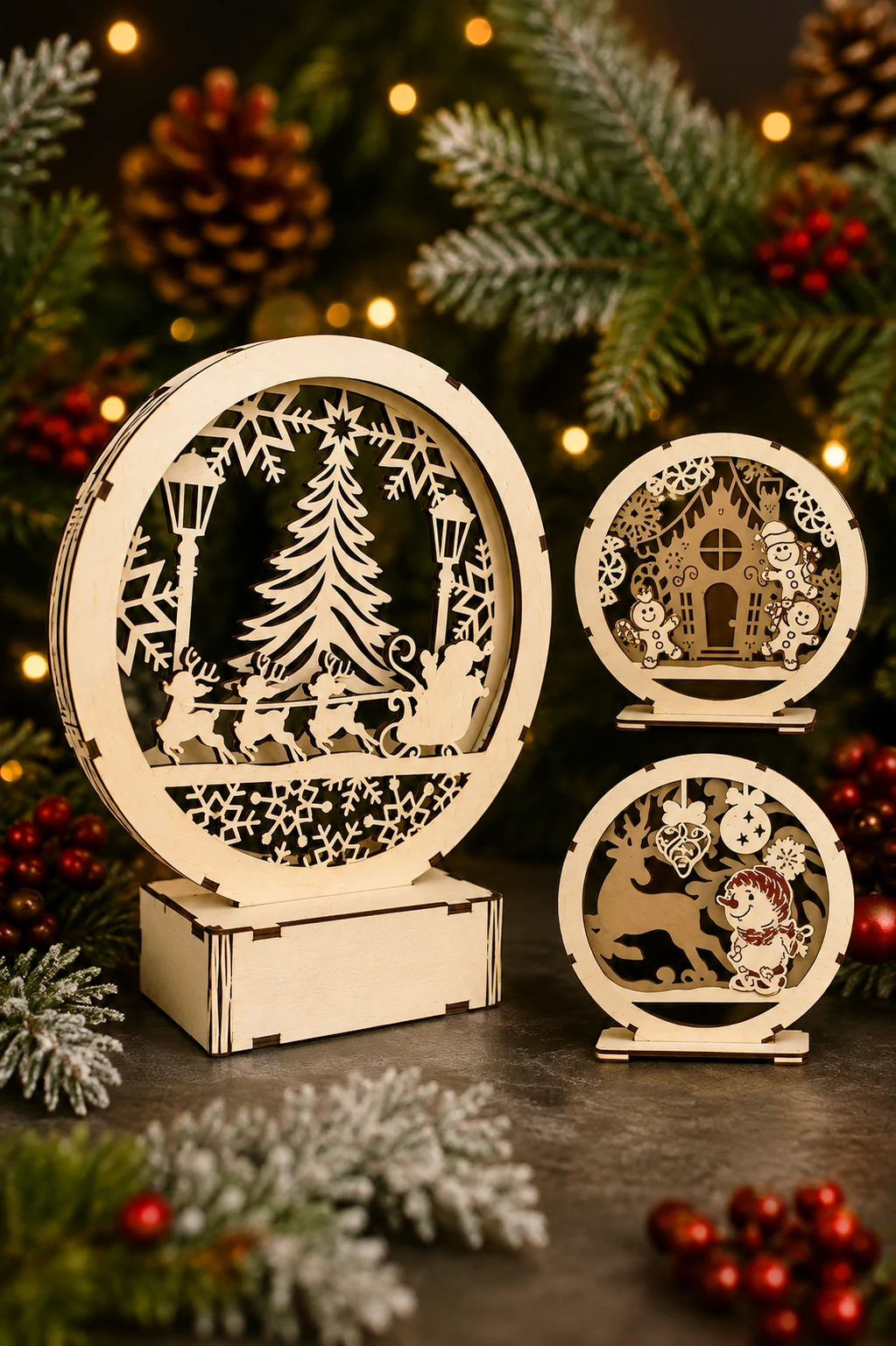
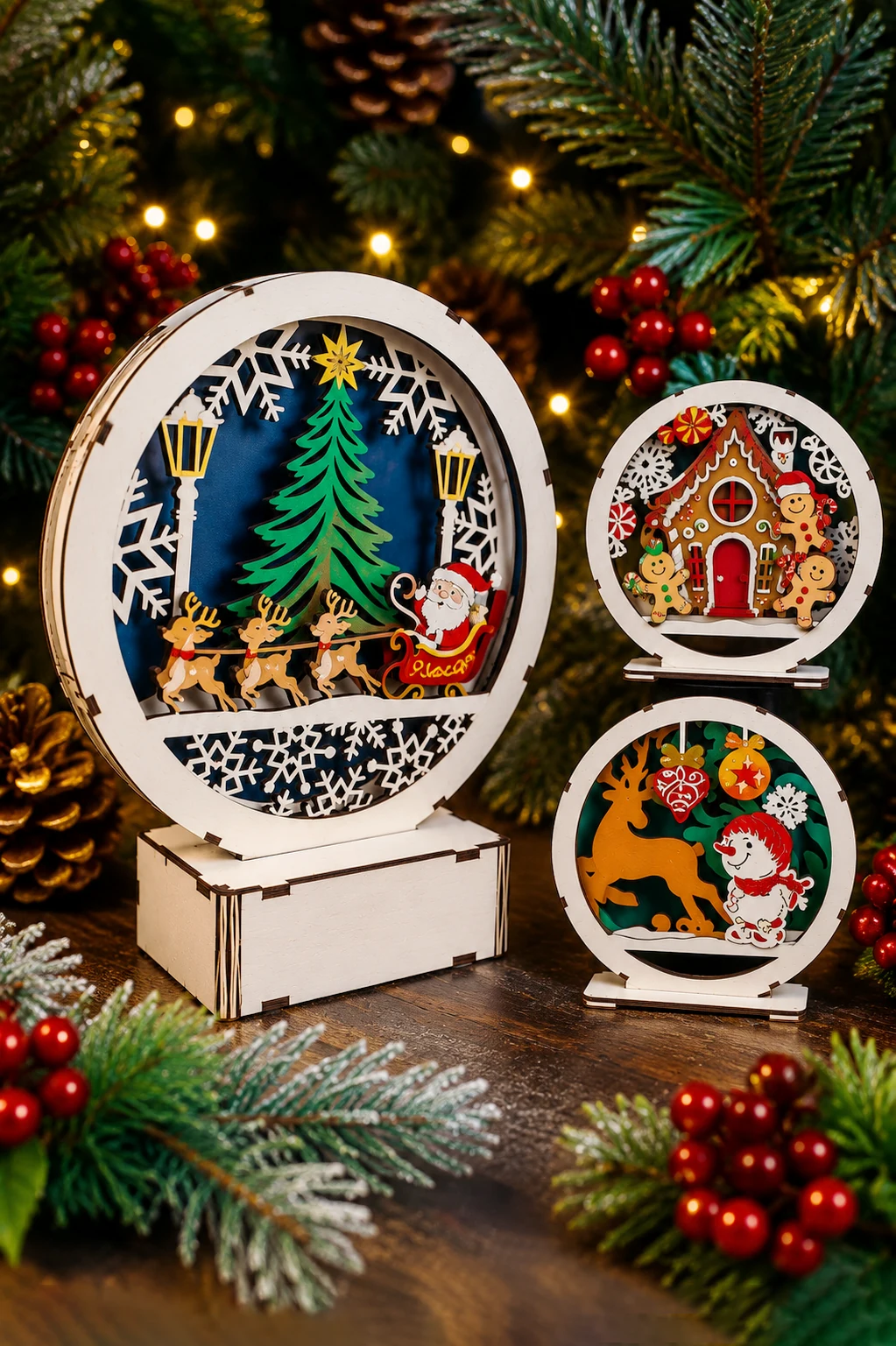
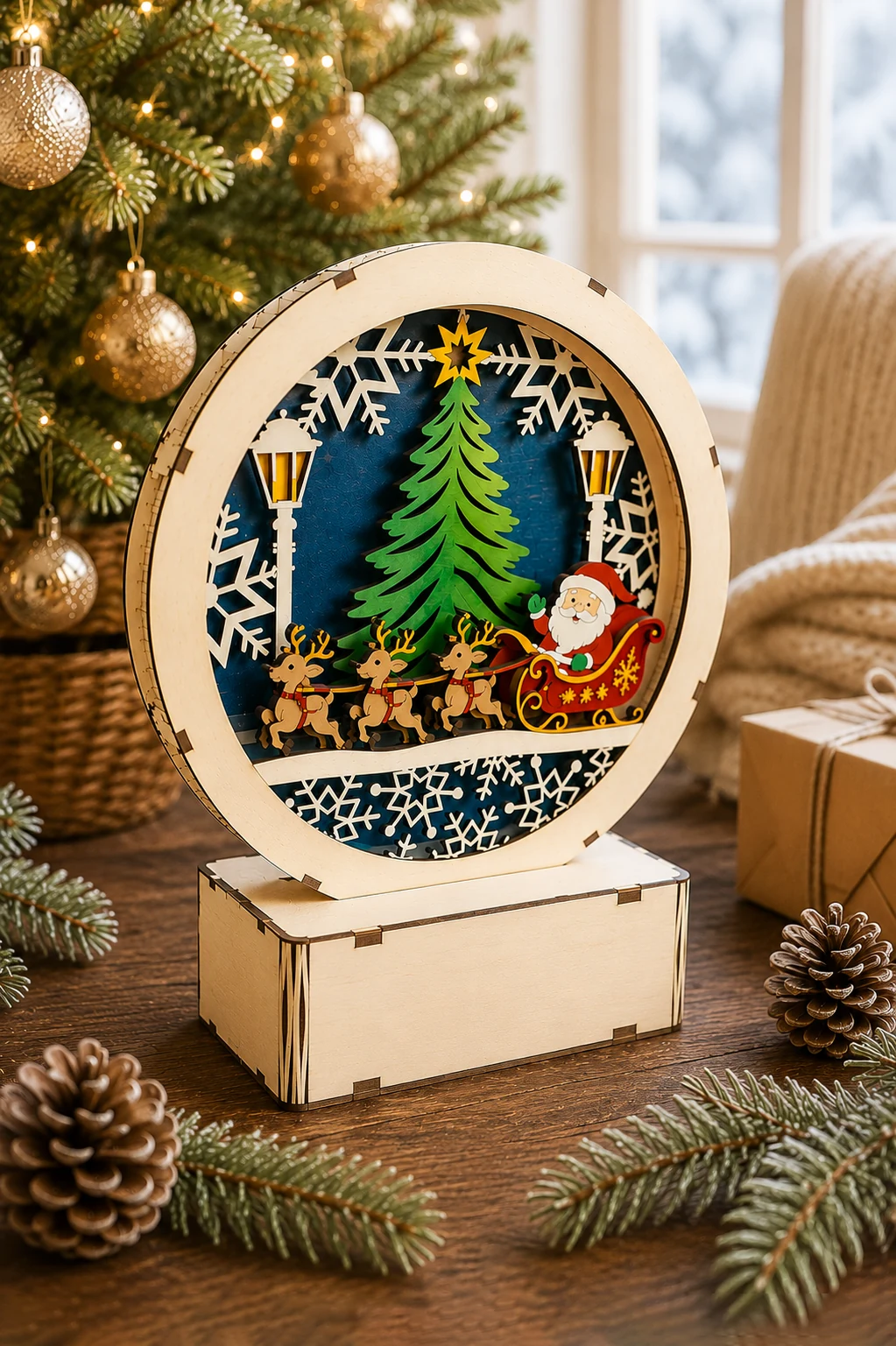
If one design is not enough for the season, this is the other kind of download: one big Christmas collection that the author describes as more than 20 complete sets, with ornaments, layered lanterns, advent calendars, stars, snowflakes and nativity scenes. The round scenes slot into a small box stand and stay upright: a large circle with a tree, Santa on his sleigh and reindeer, and two smaller ones with a gingerbread house, a reindeer and a snowman.
The first photo shows them in bare plywood, and the depth is already there from the layers alone; paint goes on afterwards. The author asks for 3 to 4 mm material and supplies SVG, DXF, AI, CDR, EPS, PDF and DWG. Most of the models need no glue, but not every one, so keep a bottle to hand.
Compare all designs side by side
| Design | What it is | Good for |
|---|---|---|
| Santa Mail, twenty-five drawers | Post box calendar with 25 pull-out drawers, 6 mm material | A drawer calendar you refill every year |
| The same grid, three more shells | Stamp, stocking and clock shells from the same bundle of 10 designs | A different calendar shape each year |
| A bauble that counts the days down | Layered countdown bauble, about 19 cm tall, 3 mm | A countdown on a shelf, no drawers |
| A dial you turn instead of a drawer you open | Tree with a number wheel from 1 to 24, slots together without glue | A countdown with nothing to refill |
| A train you assemble | Engine and four cars with numbered drawers | A calendar that doubles as a toy |
| Nice List tickets | Two engraved tickets with a name | A keepsake to hand to a child |
| A Santa Meter that turns | Round ornament with a turning dial, 10 designs | A personalised ornament with a moving part |
| The alphabet in Santa hats | A to Z letter ornaments with a Santa hat | Initials on the tree or the mantel |
| A sleigh you fill with sweets | Slot-together sleigh with two reindeer, no glue | A table piece that holds sweets or small gifts |
| A whole reindeer team | Standing reindeer and a 20 cm sleigh, 3 to 4 mm | A long shelf or mantel display |
| A Christmas village you line up on a shelf | 4 layered house fronts on stands | A shelf village or a market set |
| Round scenes that stand on a box | Layered round scenes from a large Christmas collection, 3 to 4 mm | Shelf decor in bare or painted plywood |
What to cut an advent calendar from
Drawers are the reason some of these want thicker stock. The Santa Mail maker specifies 6 mm for that bundle directly, and it is a rule worth carrying to any drawer calendar you cut: a tray cut from 3 mm ply has too much flex, it racks in the opening and catches on the runners, while at 6 mm the walls stay square and the drawer slides on its own weight. Check the thickness each maker actually lists before you cut — not every bundle above names one.
Everything else here is thinner. The Nice List tickets, the Santa Meter and the letter ornaments are ornament-weight, 3 mm or less, because they hang. On the Santa Meter, keep the dial and its cover layer thin so the needle turns without rubbing.
Where a file marks red for cut and black for engrave, set your machine to match before you send it. The train and the tickets are both drawn that way, and a lot of the detail on them is engraved rather than cut, which is what keeps the piece to a single pass.
FAQ
When should I cut an advent calendar?
Early November. It has to be assembled, filled and on the wall before the first, so give yourself the cutting, the sanding and a day for glue to dry with time to spare.
Can I resize the drawers?
Scale the whole file together, not the drawers alone. The openings and the trays are cut to a fit that allows for the kerf of your laser, and changing one without the other loses that clearance. If your first drawer is tight, sand the tray rather than recut the box.
Will these cut on a Cricut?
The flat pieces — the tickets, the letters, the sleigh panels — cut in thick cardstock, and a paper sleigh looks good on a shelf. The drawer calendars need the rigidity of 6 mm wood or MDF to work as calendars; in paper they are a picture, not a mechanism.
Can’t find the design you need?
Describe your idea in a few words and generate your own SVG design with AI.
Good to know: the files in this guide are hosted on Creative Fabrica. Downloading is free with their free trial: a payment card is needed to start it, and you can cancel the subscription at any time.