Desk Organizer SVG: 8 Free Laser Cut Files to Tame the Clutter
Every desk grows the same three piles: pens that never go back in the mug, cards and receipts with nowhere to live, and the small things that end up in a bowl because a bowl is all there is. You can buy an organizer for each of them, or you can cut the lot in an evening from a couple of sheets of plywood and have them fit your desk instead of somebody’s catalogue.
Below are eight free desk organizer SVG files, sorted by where the mess actually lives: the desk, the dresser, the wall by the door, the drawers of the craft room and the market table. For each one, what the maker states, what the photograph shows, and the one thing to check before you press start. Most of them are box builds on tabs and slots, so the end of the page is about getting joints that close properly the first time.
On the desk
Pencil holders with a face
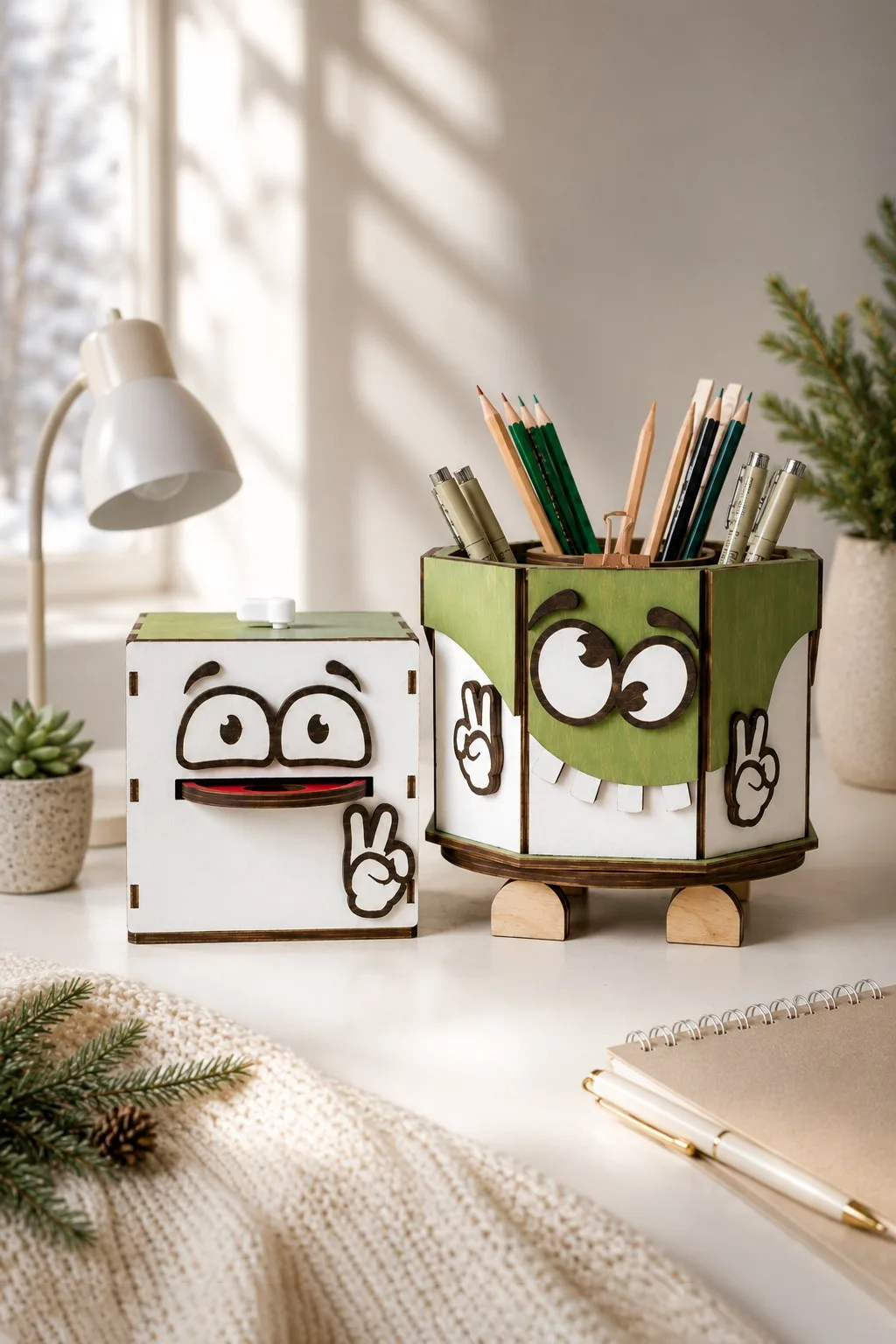
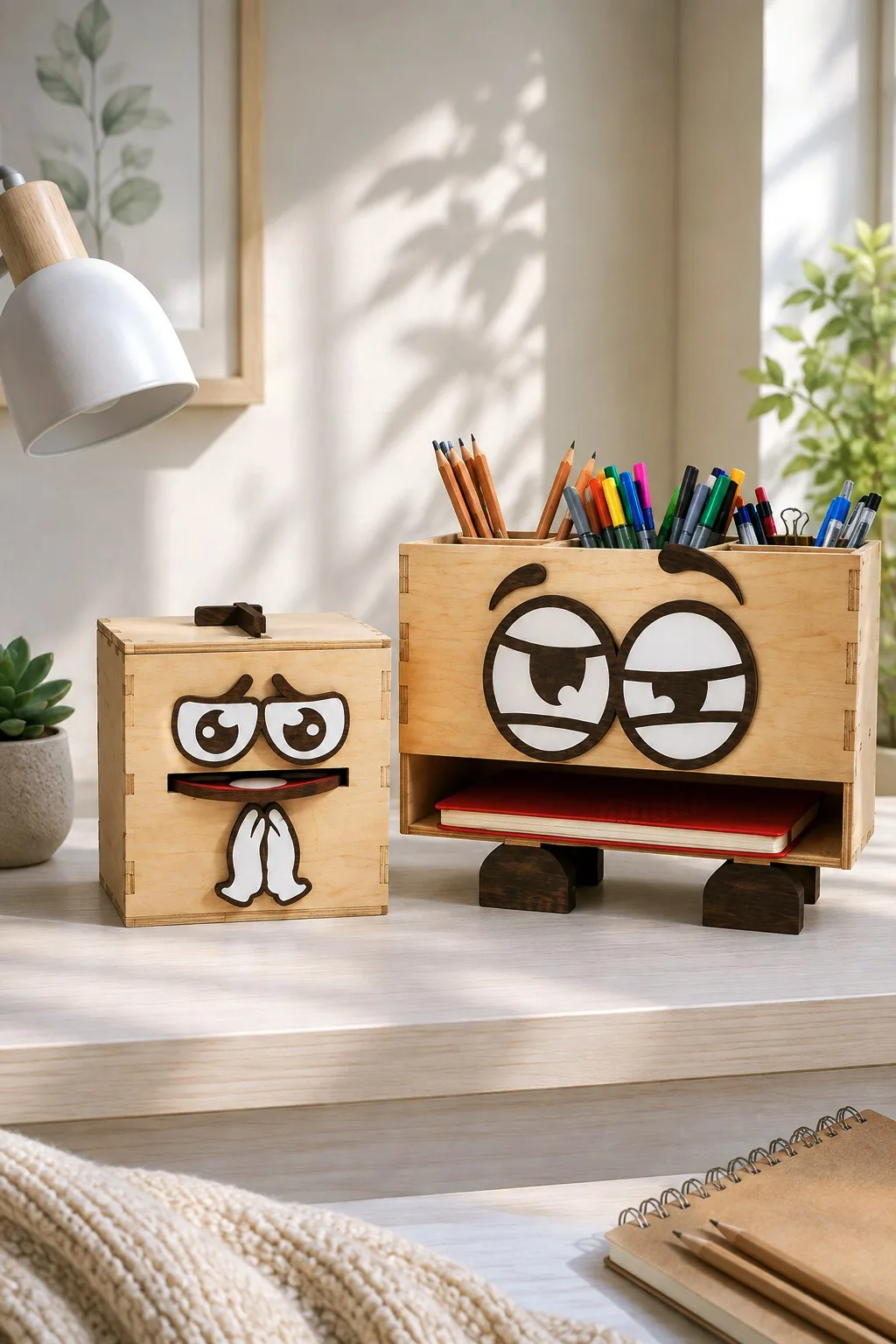
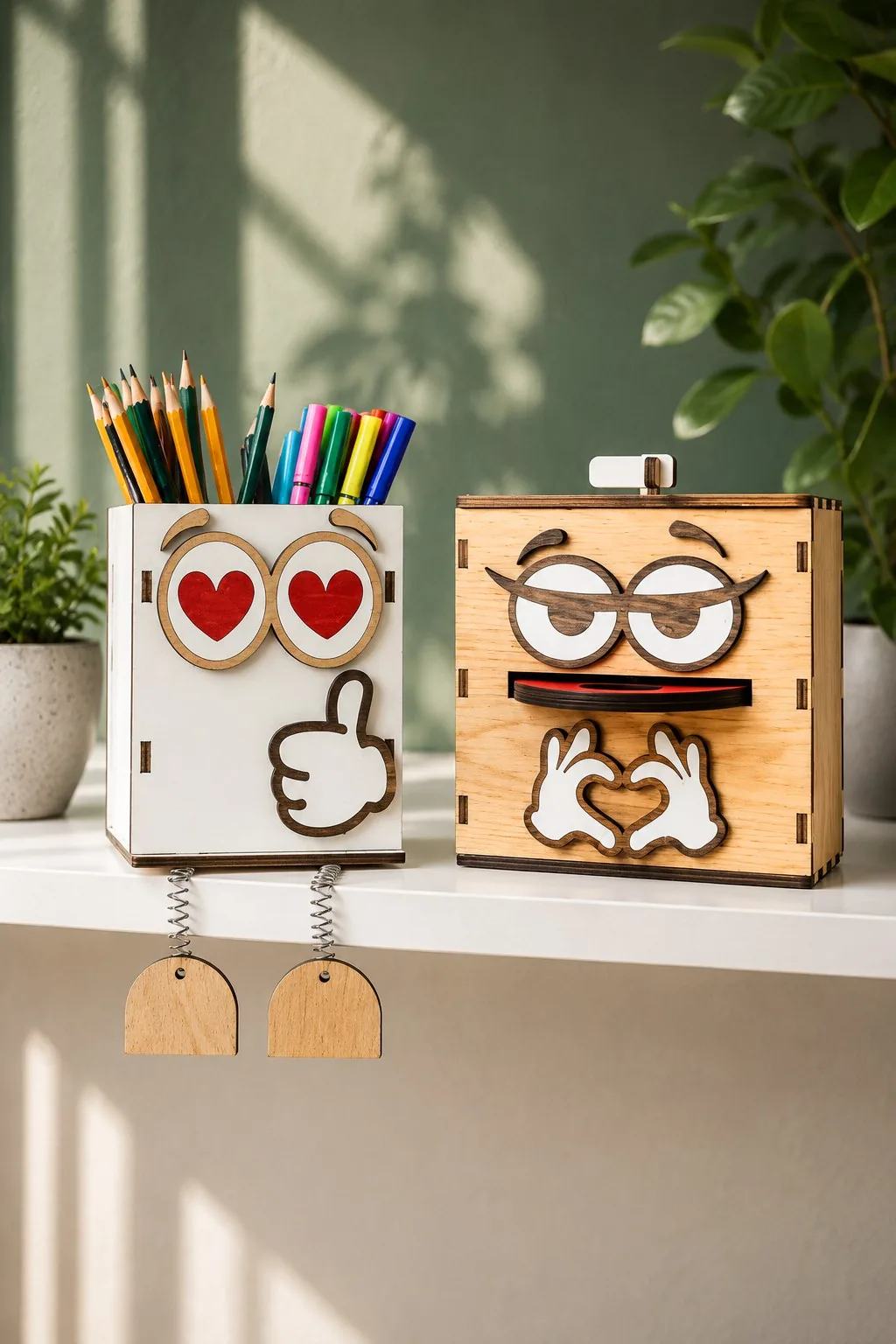
Ten designs, and every one is an ordinary box that has been given a personality. A cube with big eyes and a red open mouth, a pencil pot on arched legs with a row of square teeth, a tray with sleepy half-closed eyes and a pair of hands propped under its chin, a white holder with heart eyes and a thumbs-up, swinging its legs on two springs. Take the face off and each one is a plain box. Put it back and a child will tidy the desk just to feed it.
Three pieces make the character: the eyes, the mouth and the hands. Everything else is walls on finger joints, which you can see at the corners. That is the trick worth stealing for any box file you already own. The maker states 3 mm material and draws the joints for it, and ships SVG, DXF, EPS, PDF, JPEG and PNG.
Ten designs in the bundle.
A business card holder in two heights
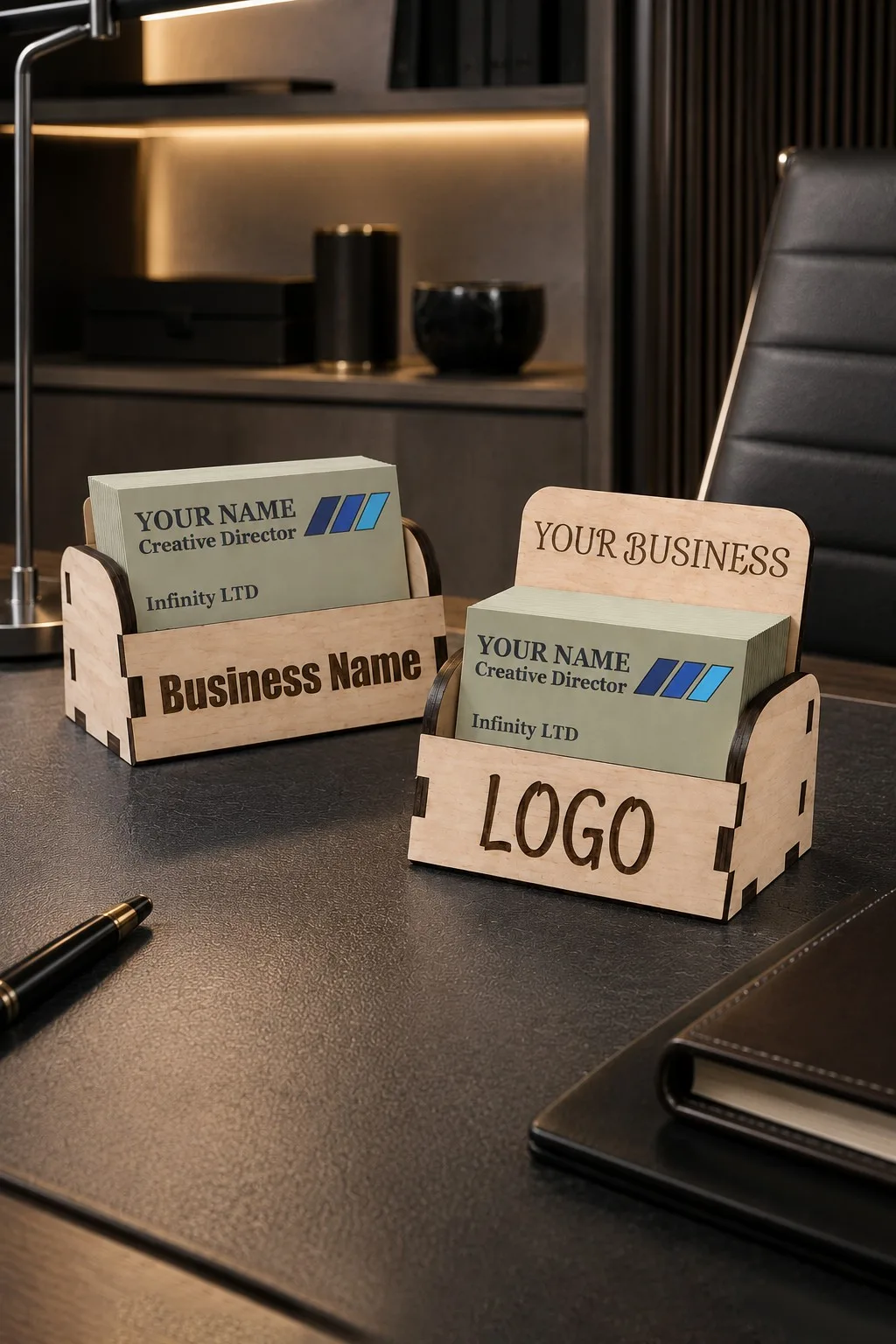
One of the most saved files we have taken apart for this site, and it is not decor at all. Two versions of one holder: a low back that shows almost the whole card, and a tall back that becomes a small sign, with room to engrave a company name above the cards and a logo on the front.
It is also a rare file with every size given: about 10 cm wide and 5.5 cm deep, 5 cm or 8.5 cm tall, drawn for the standard 8.5 by 5.5 cm card. That matters more than it sounds, because a card box has to fit: too tight and the stack jams, too loose and it flops over. The maker lists 3 mm, 3.2 mm (1/8 inch) and 4 mm wood, plywood, MDF or acrylic, ships AI, EPS, DXF and SVG, and tested it in LightBurn, LaserCut and RDWorks on Glowforge, OMTech, xTool and Thunder Laser machines.
Cut it once and it suits everyone: the engraved name is the only part that changes.
A file rack and a brush cup
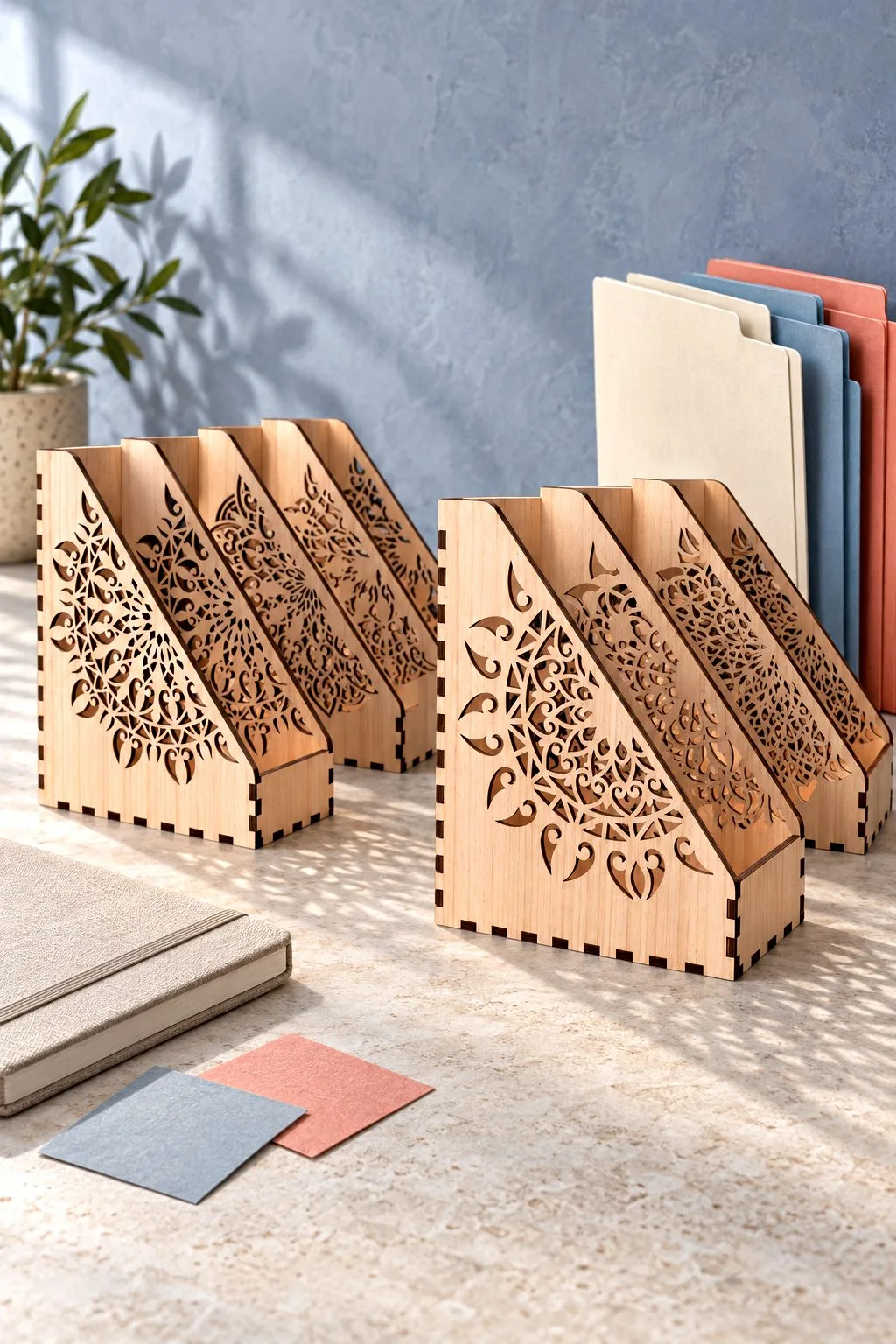
A magazine-file organizer takes the same wedge shape you already know from office supply stores, but the side panels are cut into a full mandala pattern instead of staying plain — the same finger-jointed base as everything else on this page, just with lace instead of a face. Recommended thickness is 6mm and the design scales, so a thinner sheet works too if you don’t mind losing some crispness in the cutout.
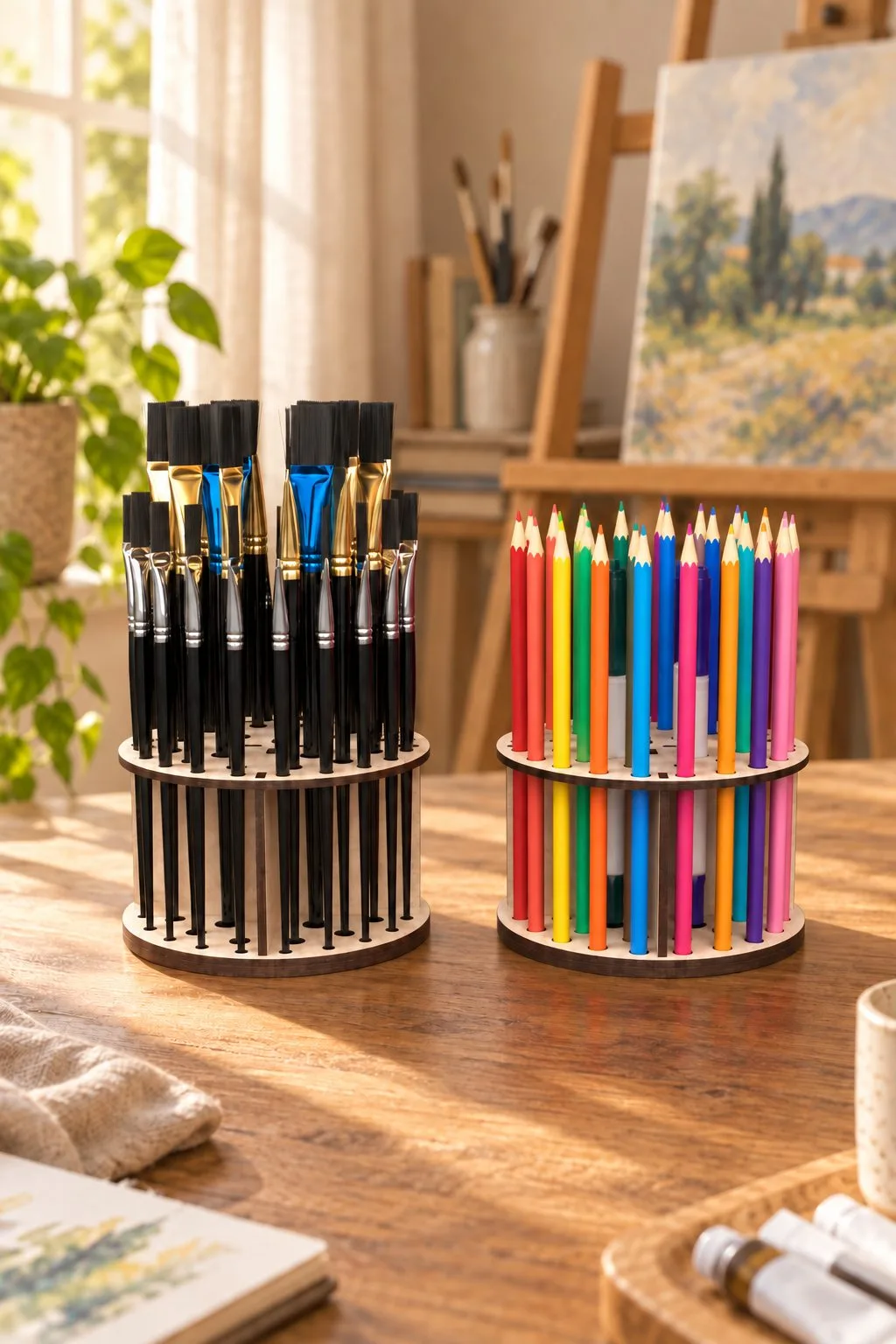
For pens and brushes, a round holder sits up on short turned legs so the drum floats above the desk instead of sitting flush. It comes as two hole layouts — one sized for brushes (20 small holes, 12 medium, 4 large), one for pens and pencils (20 holes at the rim, 12 in the middle ring, 4 in the center) — at 15cm across and 9.2cm tall. Cut it from 3mm, 3.2mm or 4mm stock.
A wall-mounted headphone hook
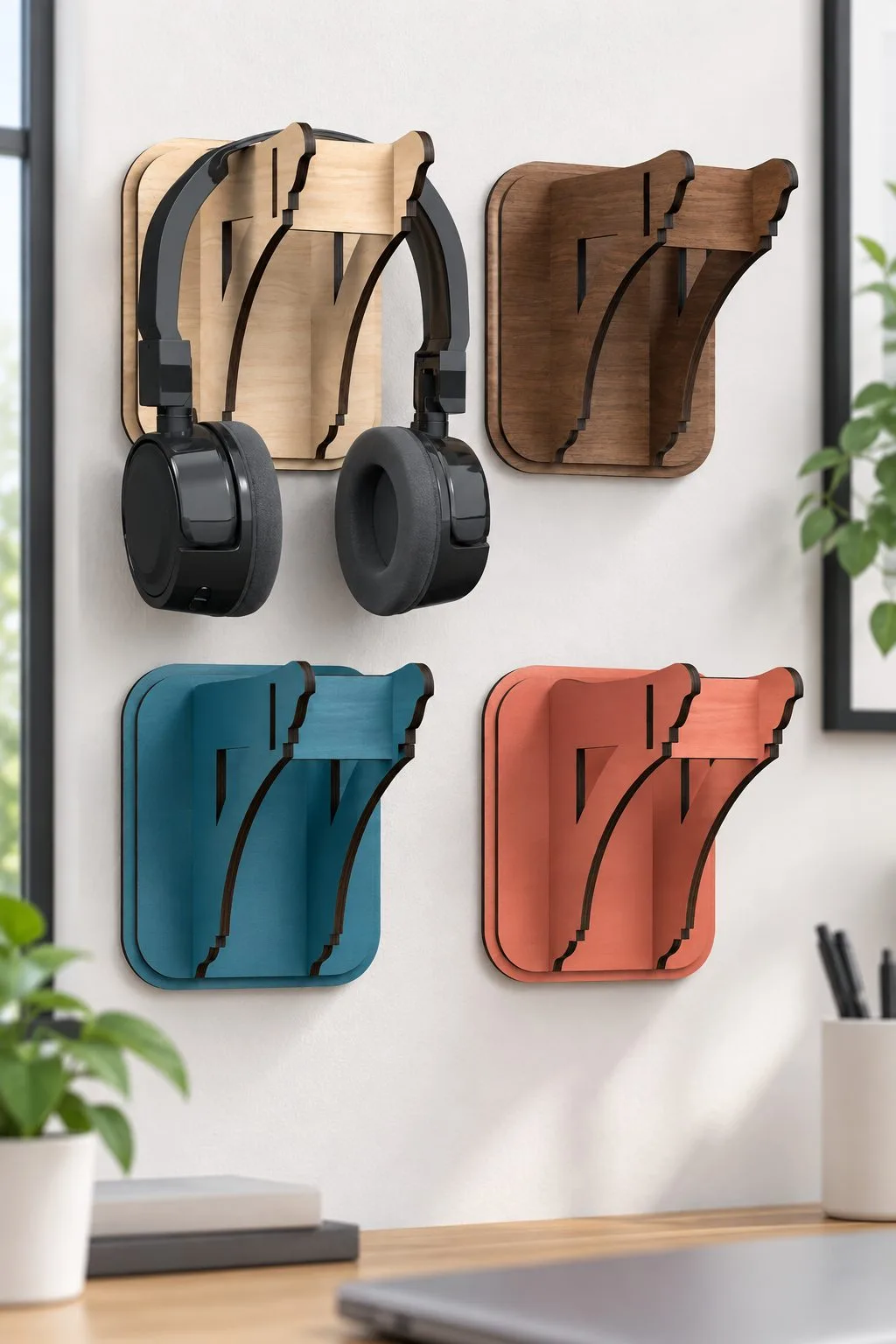
A wall-mounted headphone bracket takes the clutter off the desk entirely: a rounded backplate with a curved slotted arm cut into it holds the headband so the ear cups hang free. It’s 13.5 × 11 × 11cm, ships in four colorways, and mounts with glue, double-sided tape, screws, or a picture-frame cord — no hardware is forced on you.
On the dresser
A rainbow jewelry box, and one with a mirror
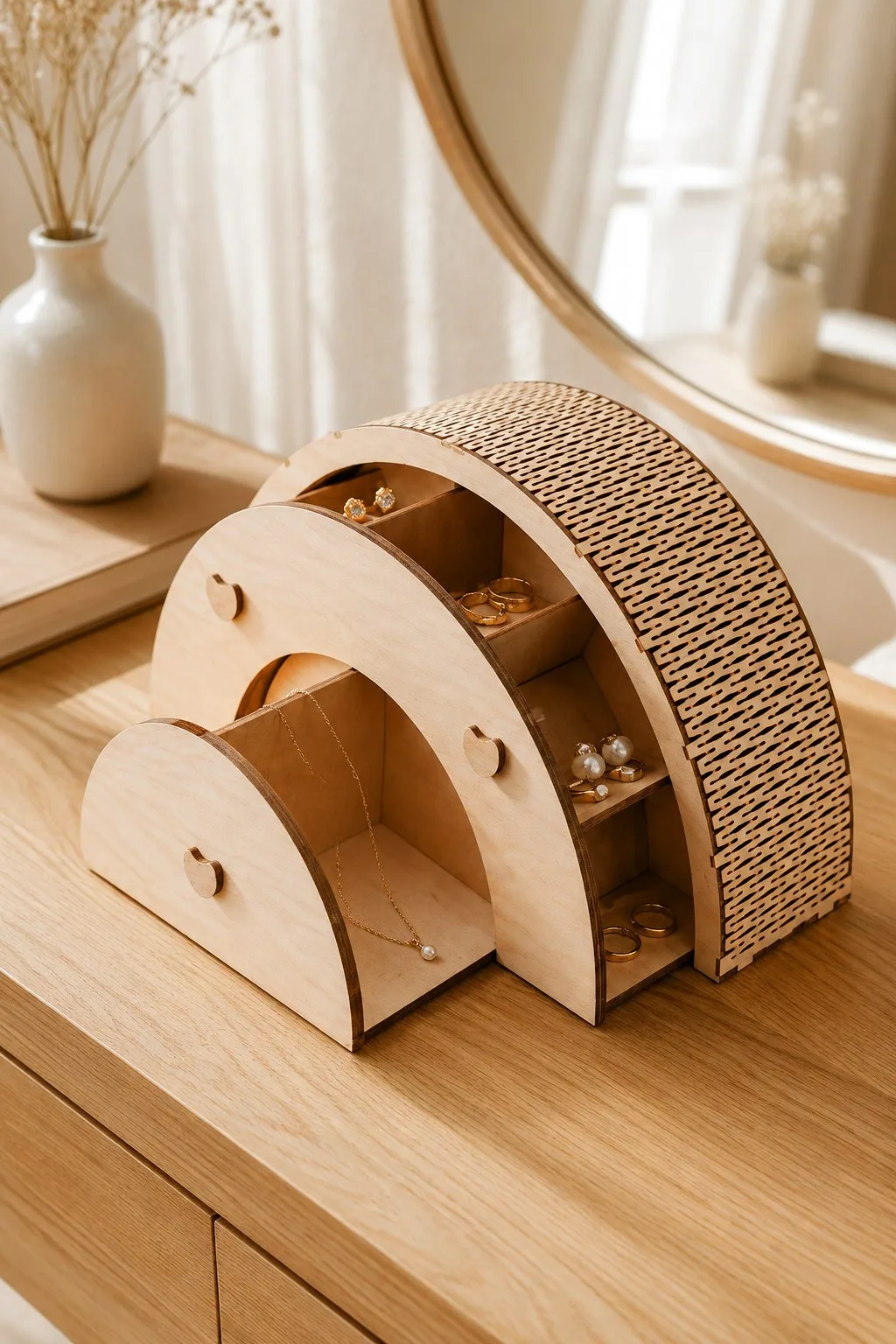
A rainbow jewelry box nests three arched drawers inside each other, stepping forward like a rainbow, each with its own small round knob. Inside, fixed dividers split them into compartments: three cells in a row for rings and studs in the big one, a long channel for a chain in the middle one. The curved back is the reason to cut it: a living hinge, row after row of short cuts that let a flat sheet of plywood bend into an arc and stay there, with no steaming and no gluing around a form. The maker optimised the file for 3 mm plywood or MDF, uses tab and slot joints, and calls the build beginner friendly. Files come as SVG, DXF, EPS, PDF and DWG; sizes are not given.
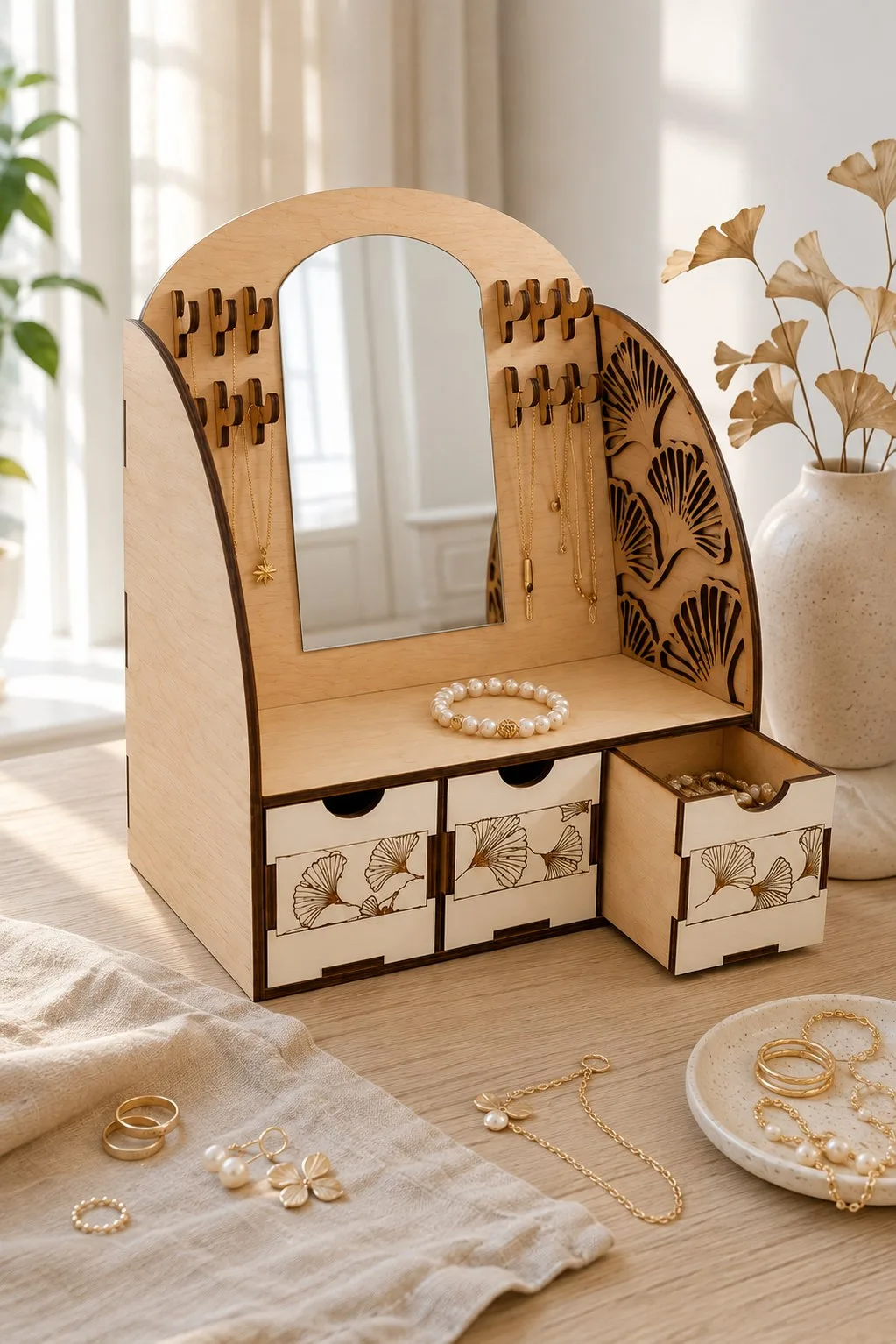
Necklaces stop tangling the moment they hang instead of lying in a dish. A jewelry stand with a mirror gives them pegs around an arched mirror, with three small drawers underneath for rings and earrings and an open shelf on top for what you wear today. One side panel is cut through into a spray of ginkgo leaves, and the ginkgo comes back on the drawer fronts. The listing is a bundle of stands and the photograph shows one of them, so check the slot width in the file against your sheet before you cut the drawers.
A folding earring stand
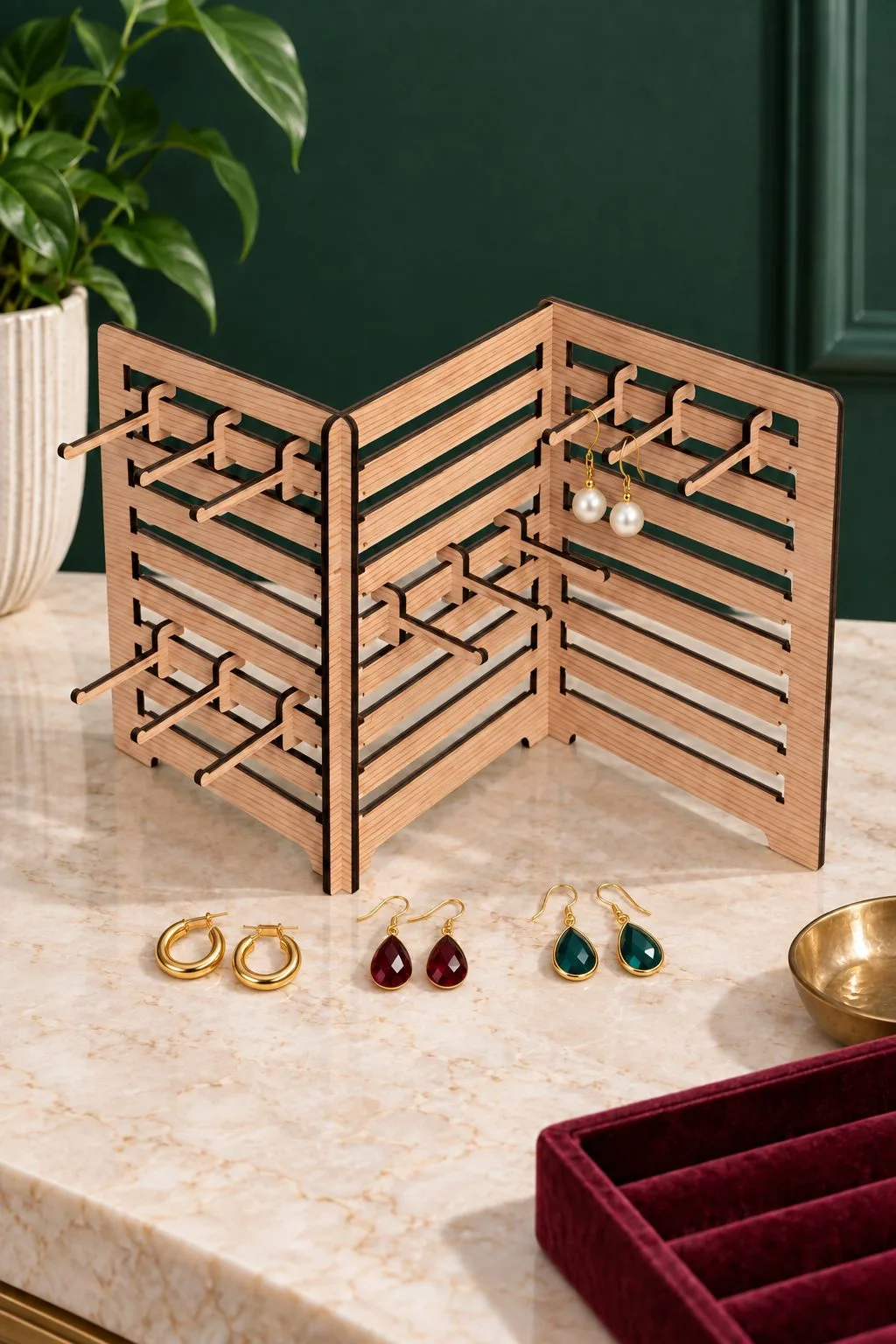
A two-panel display hinges in the middle and opens into a shallow V, each panel slatted like a ladder with short pegs standing proud of the slats for hanging earrings and small chains. It stands on its own without a separate base. Two sizes are in the file: a large panel (480×250mm) and a small one (350×250mm), cut from 3, 4, 5 or 6mm stock — the author recommends at least 4mm so the pegs don’t flex.
By the front door
A wall board and a storefront, both for keys
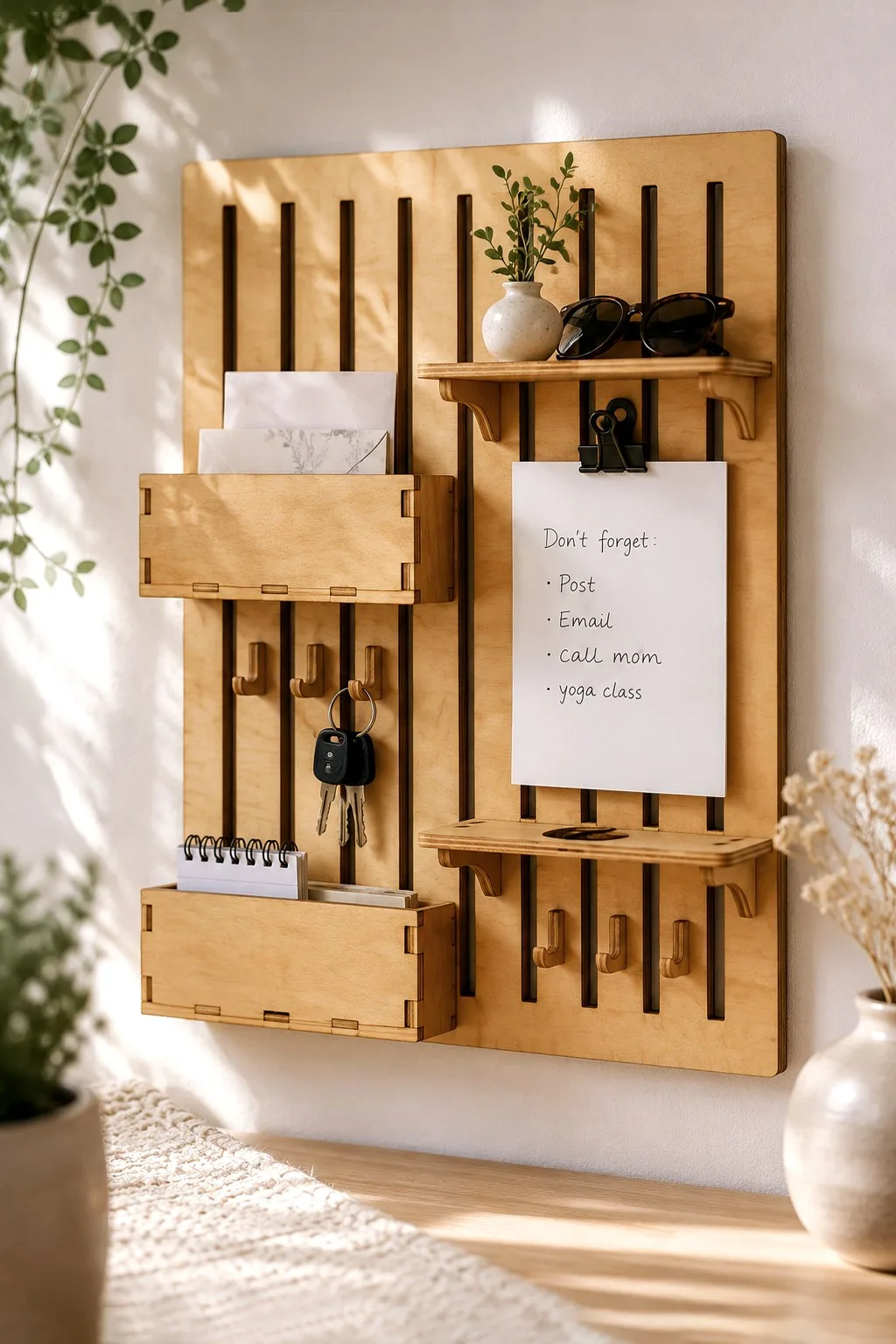
The pile by the front door finally gets somewhere to live. A slatted wall board goes on the wall and everything else slots in between the slats: two open trays for post, a small shelf for sunglasses and a plant, a clipboard for the “don’t forget” list, and hooks for the keys. You decide where each piece goes, so the layout can change when the hallway does. It is the most practical file on this page and the easiest to underestimate, because it is a system rather than an object — cut one spare tray and one spare hook the first time, you will want them within a week.
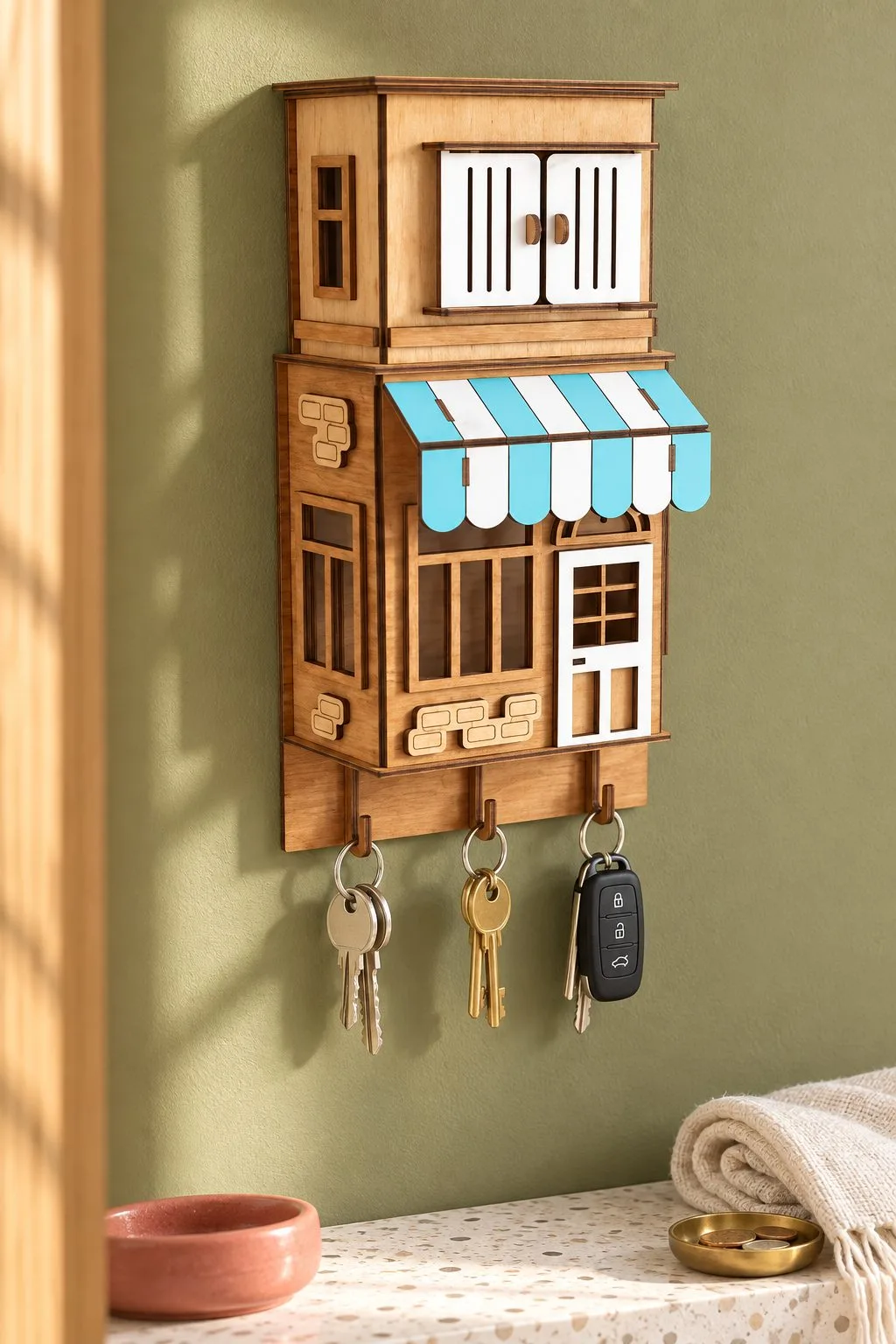
For an entryway with more wall than counter, a storefront-shaped organizer mounts flat to the wall instead: a little shop front with a striped awning and a cabinet with double doors up top, three hooks along the bottom edge for keys. Ten files per format in the archive; the seller doesn’t state a thickness for this one, so treat 3mm plywood as a starting guess rather than a confirmed spec. For both, the photograph is all we have to go on, so test the slot width on an offcut first.
A topographic catchall tray
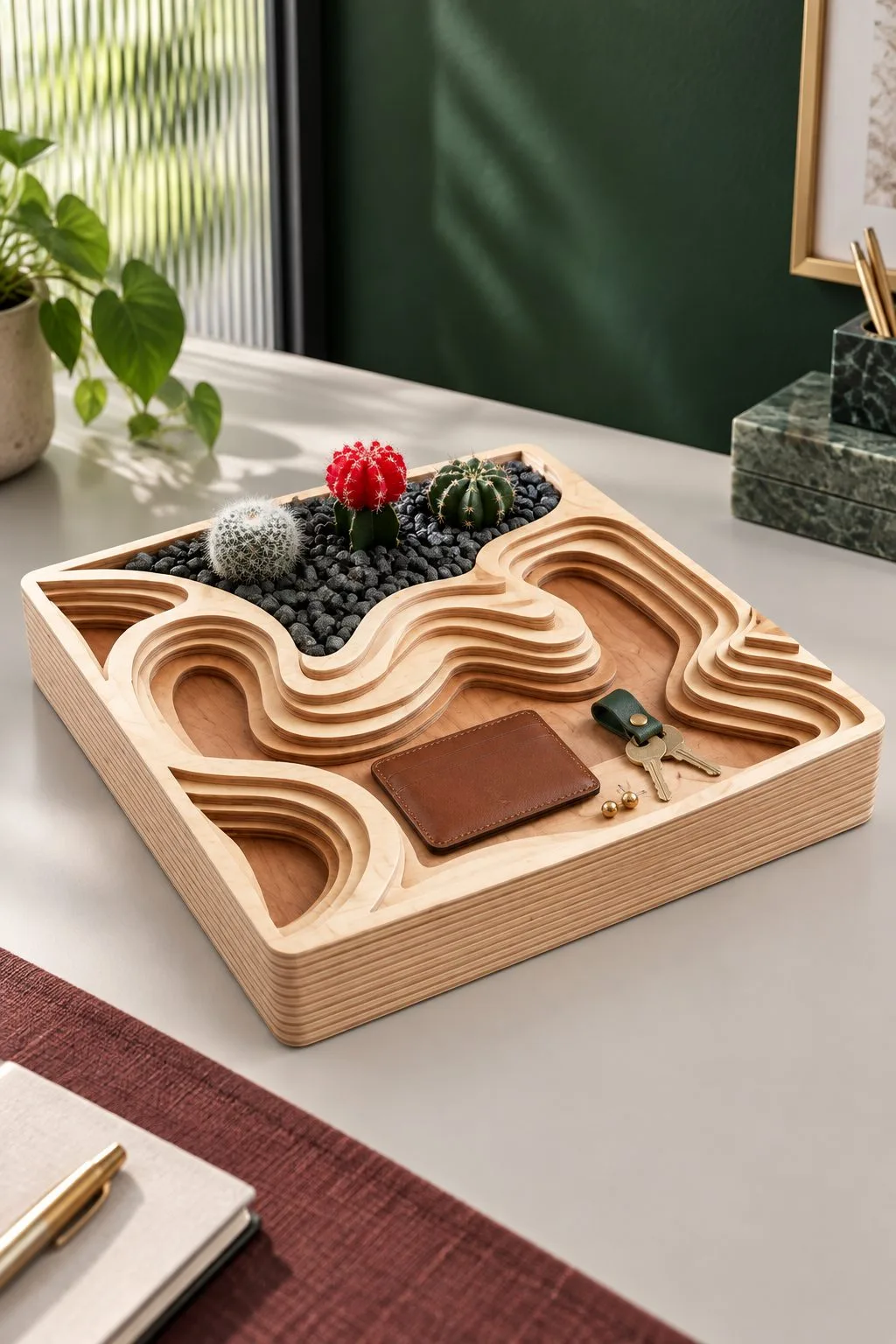
A square tray is built from stacked contour-line layers, like a topographic map, so the bottom has real depth instead of being flat — one corner sits low enough to hold gravel and a few small succulents, the rest is shallow enough for keys and a card wallet. The file has ten layer variations in the archive; thickness isn’t specified, so check with the seller for your exact stock before cutting.
In the drawer and on the craft shelf
Compartment boxes with a flip lid
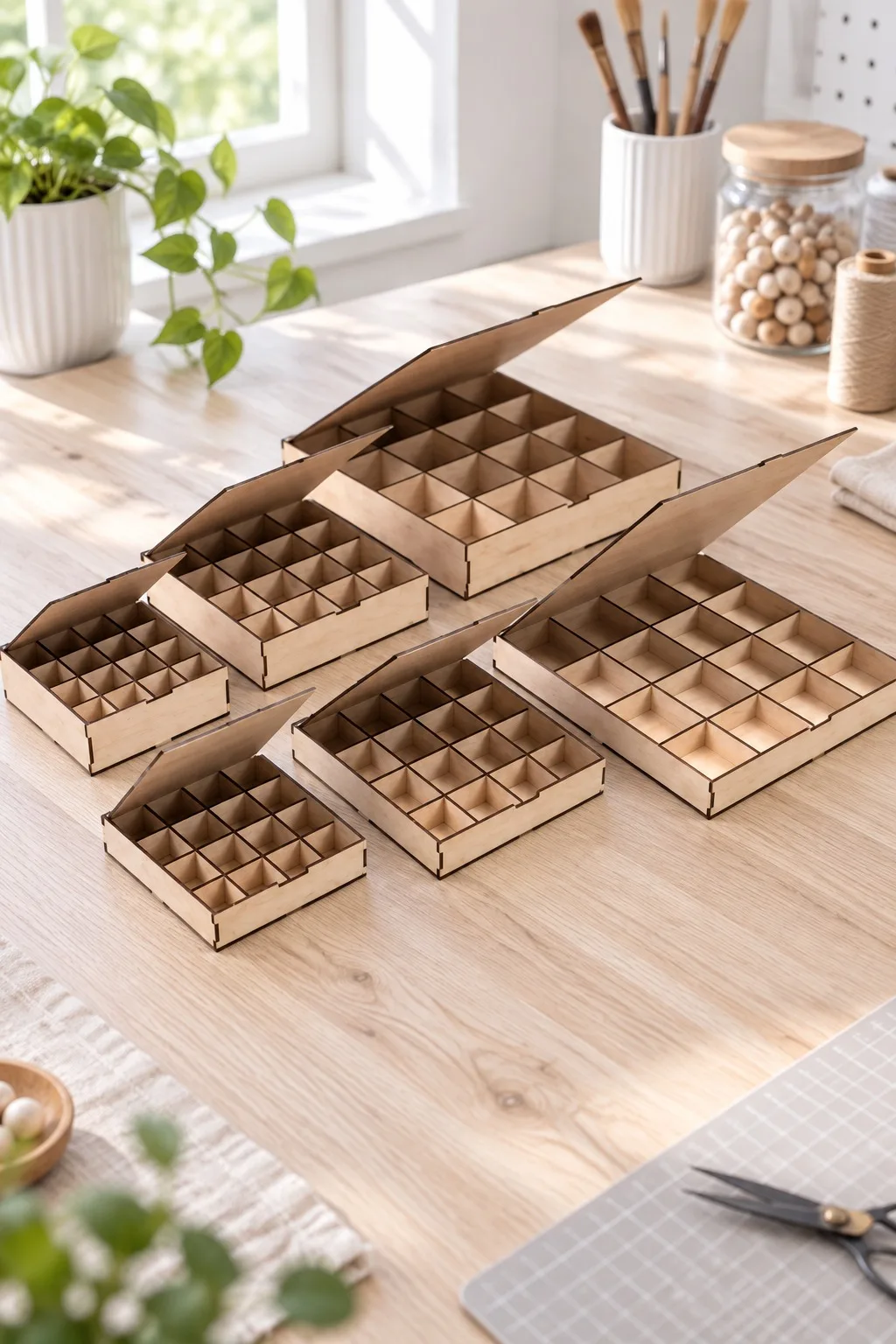
Sixteen compartments in every box: a four by four grid of dividers under a lid that flips up. That is the shape for anything small that has to be sorted rather than simply stored: beads by color, screws by size, seeds, buttons, the spare keys nobody can identify. Close the lid and the whole grid travels without mixing.
It comes in six sizes, all square: 15, 20 and 30 cm across, each either 3 or 5 cm deep. And every size is drawn for six material thicknesses: 3 mm, 1/8 inch, 4 mm, 5 mm, 6 mm and 1/4 inch, so you pick the file that matches your sheet instead of fighting the slots. Files come as CDR, SVG, DXF, PDF, EPS and AI.
Flip-lid boxes in sixteen sizes
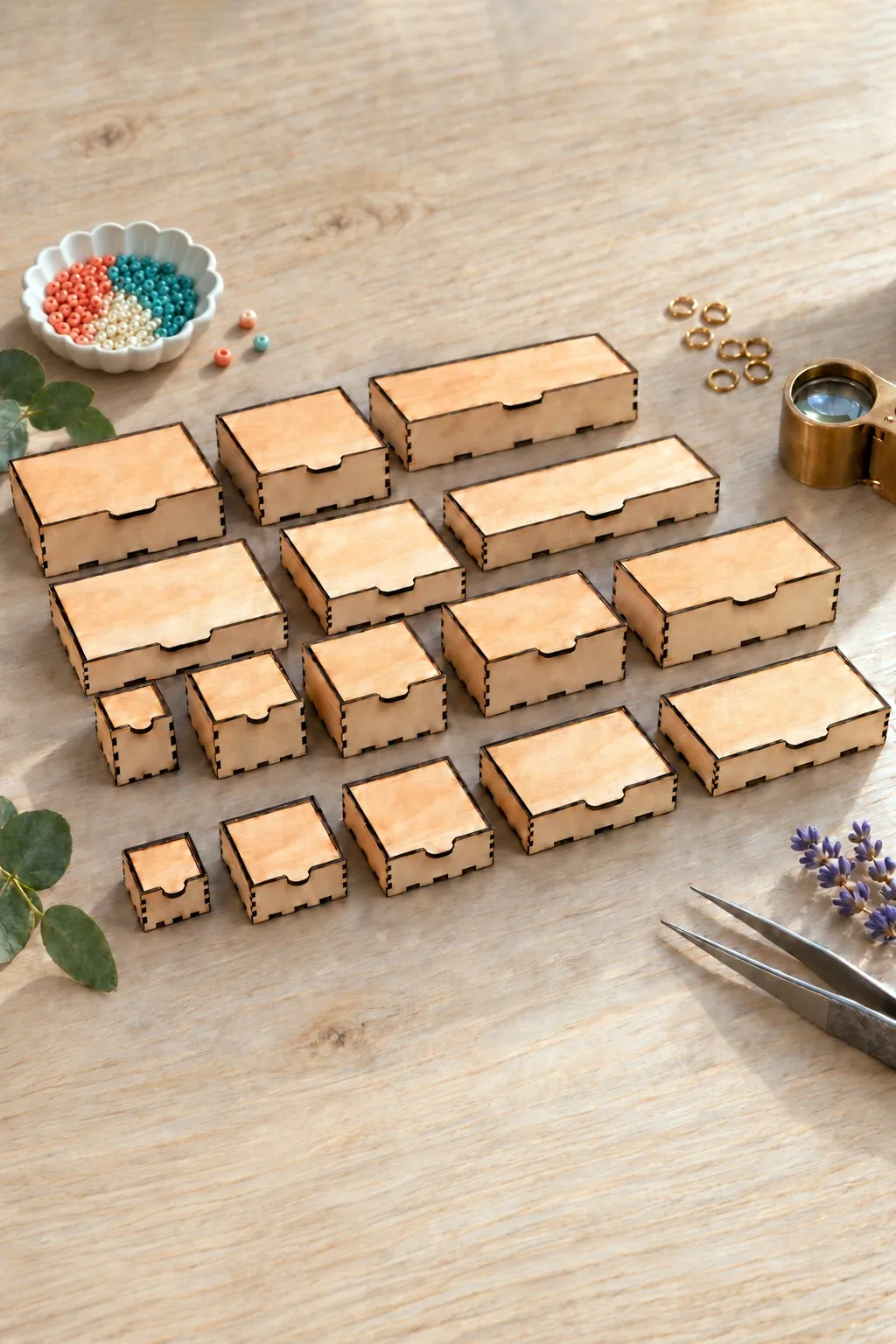
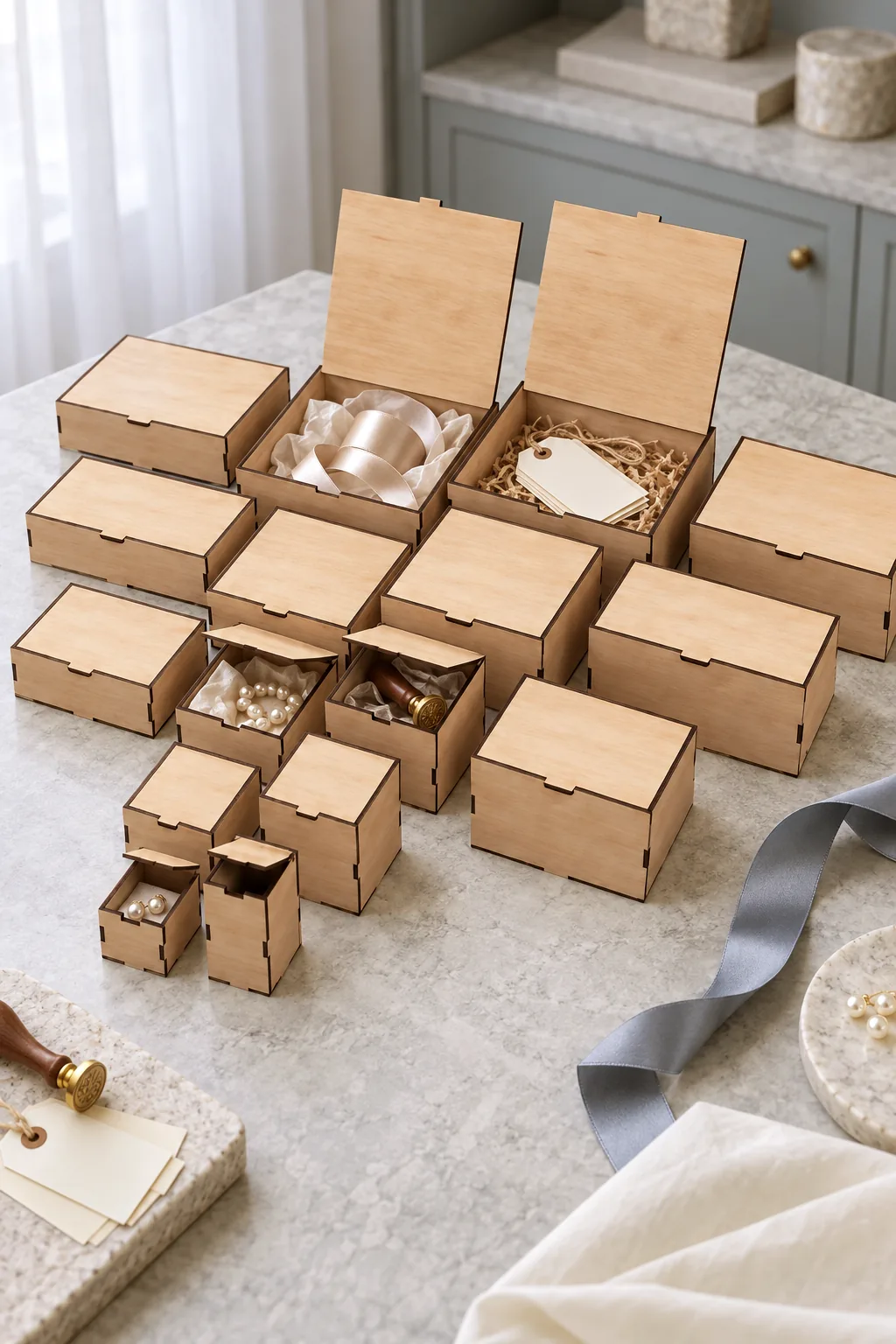
One lid design, sixteen boxes. The smallest is a 5 cm cube and the largest 20 by 20 by 10 cm; in between come squares of 8, 10 and 15 cm and oblongs of 15 by 10, 20 by 10 and 20 by 15 cm, each in a 5 cm or a 10 cm height. Line them up in a drawer and they tile it. Stand them on a shelf and they read as one set, because every lid has the same thumb notch and the same finger-jointed edge.
The open photo shows what they end up holding: ribbon and gift tags in one, pearls in another, a wax seal in a third. A tiny box with a flip lid is the nicest way to hand someone a ring or a pair of earrings, and on a laser it costs a scrap of plywood. Like the compartment boxes, every size comes drawn for six thicknesses, from 3 mm to 1/4 inch. One practical note from the maker: LightBurn users should import the DXF rather than the SVG. Files come as CDR, SVG, DXF, PDF, EPS and AI.
Sixteen sizes in the file.
On the market table
A three-tier stand, and a five-piece set
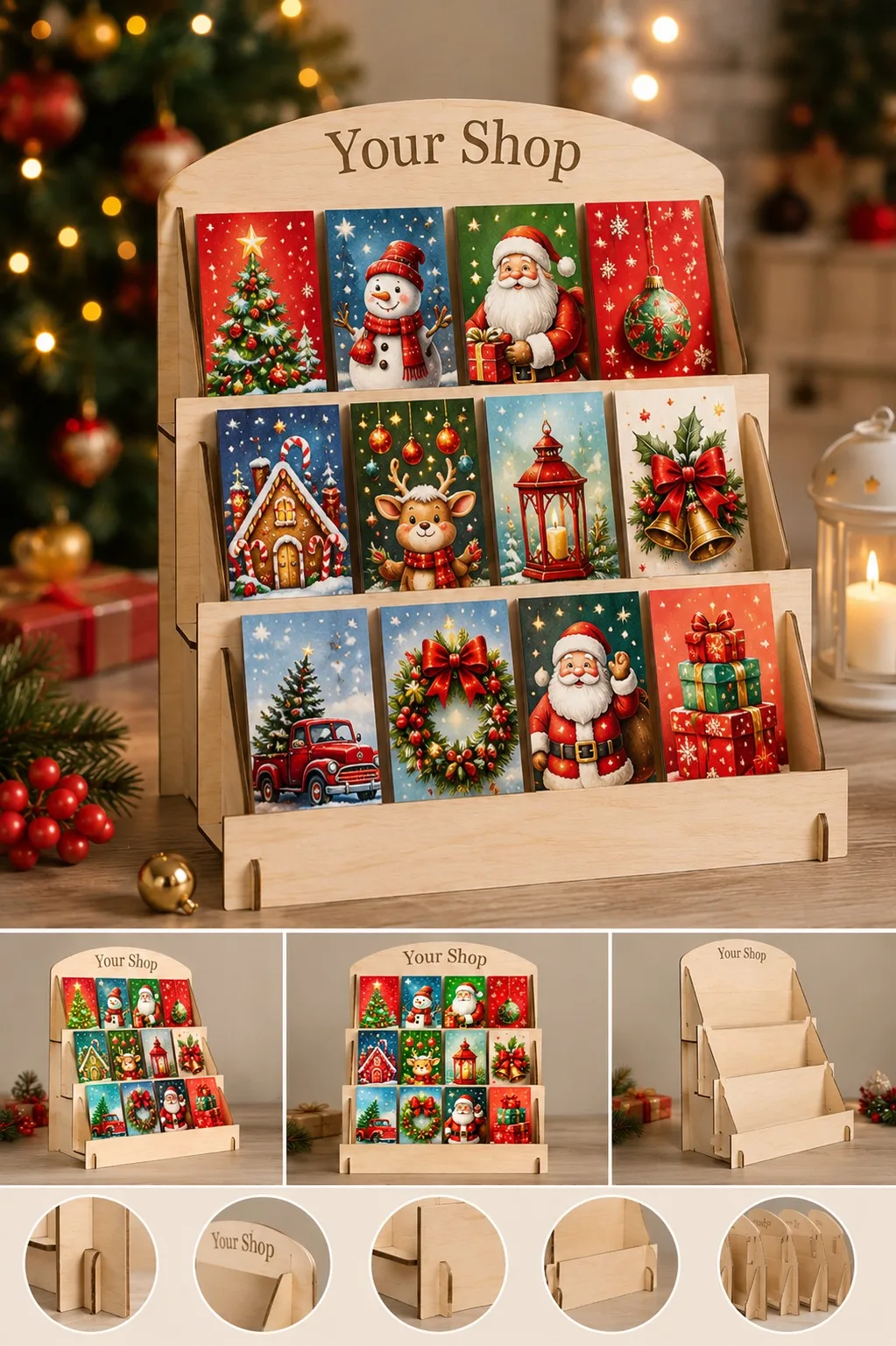
Saved even more often than the business card holder, and again it is a tool for selling rather than something to sell. A three-tier display stand gives three slanted shelves with a lip, so cards stand at an angle and stay put, and an arched sign on top with room for the name of your stall. It comes in three widths at the same height and depth: small 15 by 20 by 34 cm with a 12 cm shelf, medium 23 by 20 by 34 cm with a 20 cm shelf, and large 33 by 20 by 34 cm with a 30 cm shelf, every shelf 5.6 cm deep. Flat pack, made for fairs and pop-up stalls: it comes apart into boards for the car and goes back together on the spot. 3 mm, 3.2 mm (1/8 inch) or 4 mm wood, MDF or acrylic; AI, EPS, DXF, PDF and SVG.
Where the three-tier stand covers one product line, a five-piece set is built to dress a whole table at once: tiered card and print racks, a candle riser with cutouts sized for jars and tins, and a rotating stand for sunglasses or bracelets. Five files in the archive. One thing the seller flags directly: LightBurn can distort sizing on SVG imports for this set, so pull the DXF instead if you’re on that software.
Cutting boxes that actually close
Flat signs forgive almost anything. Boxes do not: a finger joint either closes or it does not, and a drawer either runs or sticks. Five habits save a sheet of plywood, and our guide to laser settings for plywood covers the test cuts in more detail.
Measure the sheet, not the label. Plywood sold as 3 mm is rarely exactly 3 mm, and the slots in these files are drawn for the thickness the maker had in hand. Put a caliper on your sheet before you cut. If it is off, pick a file drawn for your thickness (both sets of boxes on this page come in six versions, from 3 mm to 1/4 inch, and the card holder and the display stand take 3 to 4 mm) or adjust the kerf offset in your laser software. Do not scale the whole design to fix a slot: every hole and every drawer changes with it.
Cut one corner first. Before the full job, cut a single joint: two small pieces that meet at a corner. If they press together with a firm push and stay, run the file. If they fall apart or refuse to go in, fix the power or the offset now, not after the whole sheet.
Paint before you glue. The puzzle maker in our wooden toy files says it outright, and it holds here too: the faces on the pencil holders, the drawer fronts and the name plate on the card holder are all easier to paint lying flat than in the corner of an assembled box.
Leave the living hinge dry. The back of the rainbow box bends because the cuts let it. Glue in those cuts stiffens the hinge and can crack it. Glue only where the hinge meets the side panels, and bend it slowly the first time.
Not every box is glue-free. Most of these hold on tabs and slots, but a small drop of wood glue at the corners is what makes a drawer survive being pulled every morning. Read the listing: some makers say plainly that glue is part of the build.
Which one to cut first
Never cut a box before? The smallest flip-lid box: a 5 cm cube is the cheapest test of your slots you will ever run. Sorting beads, screws or seeds? The compartment boxes. Want something you will use tomorrow morning? The key board by the door. Need a present? The jewelry stand or the rainbow box. Selling at fairs? The display stand first, then the card holder, because one shows your work and the other hands out your name. And if there is a child in the house, the pencil holders with faces, and let them choose the expression.
More stands, boxes and gifts live in our Laser Cut Craft Ideas collection, and the kitchen side of the story, with tea stations, conversion charts and flower coasters in their own box, is in our kitchen SVG laser cut files.
FAQ
What thickness do desk organizer SVG files need?
Whatever the maker drew the joints for. On this page that is 3 mm for the pencil holders and the rainbow box, 3 to 4 mm for the card holder and the display stand, and anything from 3 mm to 1/4 inch for the two sets of boxes, which ship a separate version for each thickness. Flat pieces do not care about thickness; boxes do.
Do laser cut organizers need glue?
Most of these hold on tabs and slots and can be taken apart again. A little wood glue at the corners makes drawers and trays last longer, but keep it out of a living hinge.
Can I sell what I cut from these files?
Check the licence on each Creative Fabrica listing before you sell. Several of these makers clearly had markets in mind: the display stand is made to pack flat for fairs, and the card holder leaves room for a customer’s own name.
Can’t find the design you need?
Describe your idea in a few words and generate your own SVG design with AI.
Good to know: the files in this guide are hosted on Creative Fabrica. Downloading is free with their free trial: a payment card is needed to start it, and you can cancel the subscription at any time.